School surveillance system best practices are defined as the documented standards and procedures that govern how cameras, access control, and monitoring technology work together to protect students and staff while respecting privacy. The PASS 7th Edition, released in may 2026, sets the current benchmark for layered K-12 security in the United States. Effective school security, also called closed-circuit television or CCTV-based campus security in industry documentation, requires administrators to balance monitoring coverage, legal compliance, and operational efficiency from the first planning meeting forward. This guide gives school administrators and safety officers a structured framework for deploying and managing surveillance systems that hold up to both safety demands and regulatory scrutiny.
1. School surveillance system best practices start with strategic camera placement
Camera placement is the single decision that determines whether a surveillance system produces usable evidence or expensive blind spots. Indoor hallway cameras should be mounted at 2.5–3.5 meters to balance facial clarity with tamper resistance. That height keeps lenses above student reach while keeping faces in frame at a resolution sufficient for identification.
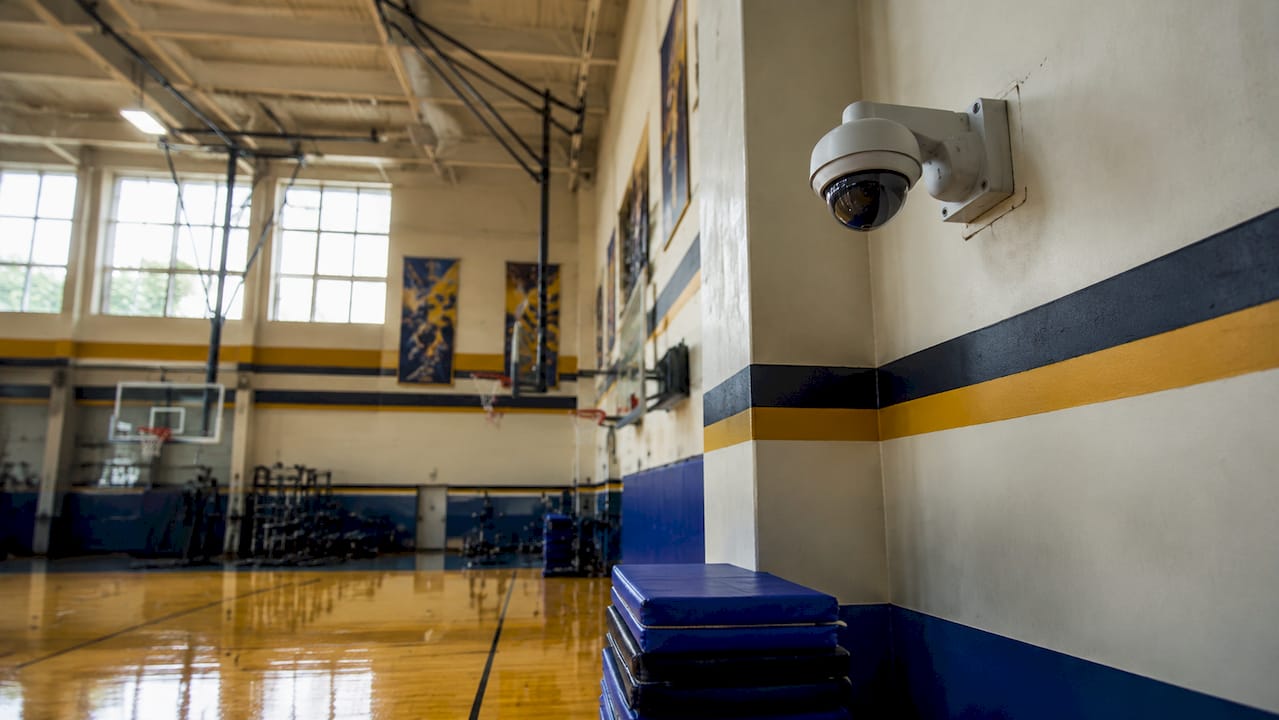
Gymnasium cameras require a different approach. Wall-mounted cameras at 4–5 meters outperform ceiling mounts in large-volume spaces because they maintain a consistent angle and reduce the distortion that comes from extreme overhead perspectives. Ceiling mounts in gyms often produce footage where faces are obscured by the top of a head.
Outdoor placement demands attention to sun path. Angling cameras north or south outdoors reduces direct sun glare that washes out images during morning arrival and afternoon dismissal. That single adjustment can mean the difference between footage that identifies a person and footage that shows only a silhouette.
Privacy zones are non-negotiable. Cameras must never cover bathrooms, locker rooms, or changing areas. Most modern network video recorders support privacy masking, a software feature that blacks out defined zones within a camera’s field of view. Document every privacy mask configuration in writing and review it annually.
Pro Tip: Walk the campus at 7:00 AM and 3:00 PM before finalizing camera angles. Those are the highest-traffic moments, and sun position at those times will expose glare problems that a midday site visit misses entirely.
| Zone | Recommended mount height | Camera type |
|---|---|---|
| Indoor hallway | 2.5–3.5 meters | Fixed dome |
| Gymnasium | 4–5 meters (wall) | Wide-angle fixed |
| Exterior entrance | 3–4 meters | Vandal-resistant dome |
| Parking lot | 5–6 meters on pole | PTZ or wide-angle |
2. Comprehensive system design and technology integration
System design failures almost always trace back to one root cause: hardware was purchased before infrastructure was planned. NVR capacity must be confirmed before any camera order is placed, because channel count, storage duration, and future scalability all depend on it. A 16-channel NVR installed today becomes a bottleneck the moment a grant funds six additional cameras next year.
Storage planning requires four inputs: camera count, frame rate, recording type (continuous versus motion-triggered), and retention policy. Planning storage needs upfront prevents the common scenario where a school discovers its system only retains 48 hours of footage when investigators need footage from five days prior.
Camera resolution must match the identification task for each zone. Pixels-per-foot combined with lens focal length determines whether a camera can identify a face at 20 feet or only detect that a person was present. Entry points and cash-handling areas need higher resolution than wide-area parking lot coverage.
Integrating electronic access control alongside surveillance multiplies the value of both systems. A door-forced-open alarm from an access control panel paired with a camera clip from that door gives administrators a complete picture of an incident in seconds. For a practical overview of how these systems connect, the access control integration guide from YDA Security Systems NYC covers the technical steps in detail.
Pro Tip: Commission the full system across three lighting conditions: bright daylight, overcast midday, and after-dark with artificial lighting only. A camera that performs well at noon may produce unusable footage at 6:00 PM in december.
3. Developing clear surveillance policies and privacy compliance
A surveillance system without a written policy is a legal liability. Schools act as data controllers under applicable privacy law, which means administrators bear direct responsibility for how footage is collected, stored, accessed, and deleted. Transparency and proportionality are the two legal tests every camera deployment must pass.
A compliant surveillance policy covers five areas:
- Purpose statement. Define exactly why each camera exists. “General security” is too vague. “Monitoring the main entrance to verify authorized entry” is specific and defensible.
- Access controls. Name the specific roles authorized to view live or recorded footage. Limit access to the principal, designated safety officer, and law enforcement with a formal request.
- Retention schedule. Set a defined retention window based on your district’s legal requirements. Retain footage longer only when an incident is under active investigation.
- Privacy mask documentation. Record every masked zone in a configuration log. Update the log whenever camera positions change.
- Communication plan. Notify staff, parents, and students about the existence and scope of surveillance through posted signage and annual written disclosure.
Reviewing the policy annually is not optional. School layouts change, staff roles change, and state privacy regulations evolve. A policy written in 2023 may not reflect current legal requirements in 2026.
4. Leveraging technology for proactive safety and monitoring
Reactive surveillance, reviewing footage after an incident, is the minimum standard. Proactive surveillance uses analytics to prevent incidents before they escalate. Surveillance analytics review footage in real time and send alerts when unusual activity is detected, which is particularly valuable for schools operating with lean security staffing.
Effective school security requires daily collaboration across physical security, administration, and IT network protection. That means surveillance systems must be part of the school’s broader emergency management framework, not a standalone tool managed only by the facilities team.
Alert trees and notification protocols define what happens when the system flags an event. A well-designed protocol specifies who receives the alert, what action they take within the first 60 seconds, and how the incident is escalated if the first responder is unavailable. Coordinate these protocols with lockdown and emergency drills so staff respond from muscle memory, not from reading a procedure document during a crisis.
Standalone lockdown procedures are insufficient. The School Safety and Violent Event Incident Management (SSAVEIM) framework recommends comprehensive incident management that includes post-event reunification plans. Surveillance footage plays a direct role in reunification by confirming student locations during and after an event.
5. Situational recommendations and phased implementation strategies
Not every school can deploy a full surveillance and access control system in a single budget cycle. The PASS 7th Edition addresses this directly by recommending a tiered approach that starts with the highest-impact, lowest-cost measures first.
The tiered sequence follows a clear logic:
Tier 1 secures every exterior door with patented or restricted key systems. This single step eliminates the most common unauthorized access method: a copied key. It costs far less than a camera system and closes a gap that technology alone cannot fix.
Tier 2 adds surveillance cameras at entry points, parking areas, and high-risk interior zones. At this stage, NVR capacity, storage, and policy documentation must already be in place.
Tier 3 integrates electronic access control, visitor management systems, and real-time analytics. This tier delivers the full capability of a modern school security system.
Natural surveillance through landscaping and lighting supports every tier. Trimming shrubs below window height, installing motion-activated lighting at building perimeters, and eliminating blind corners near entrances reduce risk without any technology investment. Review the campus layout annually as trees grow and portable classrooms are added, because physical changes create new blind spots that no camera can compensate for.
| Implementation tier | Primary measure | Technology required |
|---|---|---|
| Tier 1 | Restricted key systems on all exterior doors | None |
| Tier 2 | Camera coverage at entries and high-risk zones | NVR, cameras, storage |
| Tier 3 | Electronic access control and analytics integration | Full IP system, software |
Key takeaways
Effective school surveillance requires a tiered approach that starts with physical door security, builds toward camera coverage, and integrates access control and analytics as resources allow.
| Point | Details |
|---|---|
| Camera height matters | Mount indoor cameras at 2.5–3.5 meters and gym cameras at 4–5 meters for usable footage. |
| Plan NVR before cameras | Confirm channel count and storage capacity before purchasing any camera hardware. |
| Policy is mandatory | Define purpose, access rights, retention, and privacy masks in writing before going live. |
| Tiered deployment works | Start with restricted key systems at exterior doors before investing in advanced technology. |
| Analytics enable prevention | Real-time surveillance analytics allow lean teams to detect and respond to threats before incidents escalate. |
Professional school security installation from YDA Security Systems NYC
School administrators who have mapped their camera placement, confirmed NVR capacity, and drafted a surveillance policy are ready for professional installation. YDA Security Systems NYC installs school security systems for campuses across New York City, with licensed and insured technicians who commission systems across all lighting conditions and integrate cameras with electronic access control. Every installation includes a 1-year warranty and a post-installation review to confirm coverage matches the documented policy. For administrators ready to move from planning to deployment, professional camera installation from YDA Security Systems NYC delivers a system built to hold up under both daily use and regulatory review.
FAQ
What height should school security cameras be mounted at?
Indoor hallway cameras should be mounted at 2.5–3.5 meters, while gymnasium cameras perform best wall-mounted at 4–5 meters. These heights balance facial clarity with tamper resistance.
How long should schools retain surveillance footage?
Retention periods depend on district policy and applicable state law. Schools should set a defined window, typically 30–90 days, and extend retention only when footage is tied to an active investigation.
What is the PASS 7th Edition and why does it matter?
The PASS 7th Edition, released in may 2026, is the current national standard for layered K-12 security. It provides a tiered framework that guides administrators from basic door security through full electronic surveillance integration.
Do schools need a written surveillance policy?
Yes. Schools are legal data controllers and must document camera purpose, access rights, retention schedules, and privacy mask configurations. A written policy is required for legal compliance and for managing staff and parent communication.
How does surveillance analytics improve school safety?
Surveillance analytics review footage in real time and send alerts when unusual activity is detected, allowing administrators to intervene before an incident escalates rather than reviewing footage after the fact.