A school lockdown system is an integrated set of triggers, electrified door hardware, and mass-notification workflows designed to secure occupants in place and speed responder access the moment a credible threat is identified. Your immediate next steps are a site survey to map every door and its hardware type, notification to your local law enforcement liaison, and a shortlist of spaces that need hardening before any technology purchase begins.
That sequence matters because a single panic button without mapped hardware and verified responder access is not a lockdown system. Pew Research found that about 1 in 4 U.S. teachers reported their school went into a gun-related lockdown in the prior school year, which means this is an operational reality for a measurable share of districts, not a theoretical risk. A button that sends an alert to a phone app while classroom doors remain manually locked and unlocked by a teacher with a key is a communication tool, not a lockdown system.
Immediate next-step checklist:
- Conduct a door-by-door site survey: document hardware type, frame condition, glazing, and whether each door is currently electrified
- Notify your local law-enforcement liaison and confirm PSAP (Public Safety Answering Point) integration capabilities before selecting any platform
- Identify remote buildings, portables, and coverage gaps in your existing PA system
- Confirm which state Alyssa’s Law obligations apply to your district
- Assemble a planning team: principal, safety coordinator, facilities director, SRO, and IT lead
Key Takeaways
Effective school lockdown systems require integrated hardware, verified software commands, trained staff, and pre-established law-enforcement coordination — technology alone cannot substitute for any of these layers.
| Point | Details |
|---|---|
| Site survey first | Map every door’s hardware and electrification status before evaluating any platform or vendor. |
| Parallel action is critical | Detection-to-lockdown architectures that push simultaneously to access control, PA, mass notification, and PSAP can compress response to under 60–90 seconds. |
| Drill twice per year minimum | PASS guidance recommends standardized lockdown drills with a regular frequency, with law-enforcement participation included periodically. |
| Alyssa’s Law shapes specifications | Panic-alert systems must support fixed, wearable, and software initiation with direct PSAP notification; verify your state’s specific requirements before procurement. |
| YDA Security Systems NYC | Provides licensed, insured installation of electrified door hardware, access control, CCTV, and panic systems for schools across Manhattan, Brooklyn, Queens, and Staten Island. |
Table of Contents
- What every effective school lockdown system must include
- Understanding the different types of school lockdowns
- How lockdown systems must integrate across hardware, software, and responders
- Standards, laws, and policy considerations that shape system design
- How to choose the right lockdown system for your school
- How to train staff and run drills that make the system reliable
- Installation and commissioning: what a qualified contractor delivers
- Keeping the system reliable: maintenance, testing, and cybersecurity
- Clear communication plans for lockdown initiation and termination
- Roles and responsibilities of school staff during a lockdown
- Coordinating with law enforcement and emergency responders during an event
- Post-lockdown procedures and debriefing protocols
- How lockdown systems affect daily school operations
- Useful resources and standards to consult
- YDA Security Systems NYC: licensed school security installation in NYC
- Sources
- FAQ
What every effective school lockdown system must include
CISA’s K-12 school security guide is direct on this point: electrified hardware and human procedures must align for lockdown commands to work. A system that triggers a software command but cannot actuate a door lock has a critical gap. The components below represent the full coverage map.
- Panic/lockdown initiation points. Fixed wall-mounted buttons, wearable fobs, and desktop/mobile software activations give staff multiple ways to trigger a lockdown. Alyssa’s Law solution guidance recommends supporting all three modalities with a silent default alert and configurable audible/visual escalation so the alert reaches responders without telegraphing the threat to an active shooter.
- Access control and electrified locks. Magnetic locks, electric strikes, and electrified mortise locks allow software commands to secure doors remotely. Every door on the lockdown map must be electrified; non-electrified doors require a staff member with a physical key, which introduces latency and human error.
- Door hardware. Classroom-function locksets (locked from outside, always free from inside) satisfy most egress codes while keeping occupants safe. Specifying hardware against ASTM F3561 for door and glazing hardening is worth reviewing for new construction and major retrofits.
- Mass notification: PA, desktop/visual, and SMS. A looped PA announcement, desktop alert pushed to Chromebooks and Windows devices, and SMS to staff phones close coverage gaps where PA speakers are absent or inaudible. Vendor guidance indicates software-based alerts can reach campus devices in under three seconds, which matters in large buildings.
- Surveillance and camera integration. Cameras positioned at entry points and corridors let administrators and responders verify the threat location before committing to a response posture. See school surveillance best practices for camera placement guidance.
- Blue-light and visual alerts. Strobe-style visual alerts in hallways, gyms, and cafeterias reach occupants who cannot hear PA announcements. The national minimum-standards document specifically recommends blue-light visual alerts alongside looped PA messages.
- PSAP/911 integration. Direct push to the local PSAP, rather than a phone call, eliminates the relay delay and gives dispatchers structured data about the event location.
- Resilient network and backup power. Cellular backup for network connectivity and battery-backed power supplies for access-control panels keep the system functional during a power outage, which is a common secondary effect of a crisis event.
- Emergency responder access. First responders need a master key, override fob, or credential that unlocks electrified doors without requiring a staff member to meet them at the entrance.
Pro Tip: Never rely on a single notification channel. If your PA amplifier fails or a network switch goes down, a parallel SMS-to-staff path and a hardwired local trigger at the main office keep the system functional. Design for the failure, not the ideal scenario.
Understanding the different types of school lockdowns
Not every threat calls for the same response, and using the wrong lockdown type wastes time and creates confusion.
- Full building lockdown (hard lockdown). All exterior and interior doors are secured, all occupants shelter in classrooms or designated safe rooms, and no movement is permitted. Used when a credible, imminent threat is confirmed inside or immediately adjacent to the building, such as an active shooter or a weapon sighting.
- Targeted/geographic lockdown. Only the affected wing, floor, or zone is locked down while the rest of the building continues normal operations. Perimeter locking of that zone is the critical hardware requirement; interior barricading is secondary.
- Secure/hold. Exterior doors are locked and no one enters or exits, but normal interior movement continues. Appropriate when a law-enforcement activity is occurring nearby but the threat is not confirmed on campus.
- Shelter-in-place. Occupants move to interior rooms away from windows, often in response to a hazmat or weather event rather than a violence threat. Door locking may or may not be required depending on the specific hazard.
- Evacuation. Occupants exit the building via designated routes. This is the opposite of lockdown and must never be confused with it in protocol language; plain-language announcements are critical here.
For each type, the components that matter most shift. A full lockdown demands every electrified lock on the map to actuate simultaneously. A geographic lockdown requires zone-level access-control segmentation. A secure/hold primarily needs exterior door control and clear staff communication.
How lockdown systems must integrate across hardware, software, and responders
Integration is where most school security technology investments fail. Four destination systems must receive parallel action the moment a lockdown is initiated: access control (door locks), mass notification/PA, surveillance/video, and the PSAP/911 push. Sequential action, where the system notifies staff first and then locks doors, introduces latency that matters in seconds.
A detection-to-lockdown architecture that routes verified detections in parallel to all four systems can compress the attack-to-response window to under 60–90 seconds in production when properly engineered. That compression depends on two prerequisites: every door on the map is electrified, and the verification step is fast enough to avoid meaningful delay.
Verification models and their trade-offs:
- Automated detection (AI-based). Faster but carries false-positive risk. A false lockdown during a school day is disruptive and erodes staff confidence in the system. Requires explicit verification rules and fallback logic.
- Human-in-loop. An administrator or safety officer confirms the alert before the system actuates. Adds 15–30 seconds of latency but reduces false positives significantly. Most districts use this model for full lockdowns.
- Hybrid. Automated detection triggers a silent PSAP push and camera pop-up for human review; full lockdown actuates only after confirmation. This is the model most aligned with current guidance.
Common failure modes and mitigations:
- Unelectrified doors: mitigate by mapping every door before procurement and budgeting hardware upgrades as a prerequisite
- PA coverage gaps in gyms, cafeterias, and portables: mitigate with desktop/visual alert software and battery-powered wireless speakers
- Network outage: mitigate with cellular backup and hardwired local triggers at the main office panel
- Responder access blocked by locked doors: mitigate with master override credentials issued to law enforcement before an event occurs
For a technical overview of how access control, CCTV, and PA systems interoperate, the access control integration guide covers the panel-level wiring and software handshake in detail.
| Integration Layer | Primary Function | Key Failure Risk |
|---|---|---|
| Access control / electrified locks | Secure doors on command | Non-electrified doors bypass the command |
| Mass notification / PA | Alert occupants simultaneously | Coverage gaps in large or multi-building campuses |
| Surveillance / video | Verify threat location | Camera blind spots delay responder positioning |
| PSAP / 911 push | Dispatch responders with structured data | Phone-relay dependency adds critical seconds |
Standards, laws, and policy considerations that shape system design
Alyssa’s Law mandates panic-alert systems with direct PSAP notification in several states, with more states adopting it each legislative session. The law targets the panic-alert function specifically, not a particular commercial product, which means districts must verify that their chosen platform meets the technical requirements their state’s implementation specifies. Alyssa’s Law solution guidance recommends silent default alerts with optional audible/visual escalation and support for fixed, wearable, and software-based initiation modalities.
CISA and PASS K-12 guidance both frame lockdown technology as one layer in a broader security program. PASS Safety and Security Guidelines (6th ed.) recommends standardized lockdown drills at least twice per year and law-enforcement participation at least once every two years, and it explicitly warns against single-product purchases that ignore the surrounding layers of physical hardening, policy, and training.
ASTM F3561 provides the technical standard for door and glazing hardening. When specifying new construction or major retrofits, referencing this standard in your RFP gives contractors a measurable performance target rather than a vague “reinforced door” requirement.
Fire code and egress. Every electrified lock must be specified as fail-safe (unlocks on power loss) or fail-secure (remains locked on power loss) in coordination with your local Authority Having Jurisdiction (AHJ) and fire department. Most classroom doors must be fail-safe to comply with life-safety egress requirements, which means a power outage unlocks them. Your backup power strategy must account for this.
Action item: Before finalizing any system scope, confirm your local PSAP’s technical capabilities. Some PSAPs accept structured data pushes via platforms like RapidSOS; others require a voice call. That distinction changes your integration architecture.
How to choose the right lockdown system for your school
Selection starts with a site survey, not a vendor demo. Understanding what you have before evaluating what to buy prevents the most common procurement mistake: purchasing a platform that cannot actuate the doors it is supposed to lock.
Procurement checklist:
- Complete a door-by-door hardware inventory: type, frame condition, glazing, and electrification status
- Confirm PSAP integration capability with your local dispatch center
- Verify that the platform supports your device mix: Chromebooks, Windows, digital signage, and staff mobile devices
- Require documented egress and fire-code compliance from every vendor
- Confirm training and maintenance are included in the base contract scope, not optional add-ons
- Assess cybersecurity posture: network segmentation, MFA for admin consoles, patch management policy
- Request service-level agreements for response time and parts availability
Questions to ask every vendor:
- Which specific doors will lock on command, and how do you verify that each one is electrified?
- How do first responders override locked doors without staff assistance?
- What happens to the system on power loss and on network loss, independently?
- Which device platforms receive the alert, and how quickly?
- How do you support lockdown drills and test failover without disrupting the school day?
Red flags to walk away from:
- A vendor who promises full-building lockdown without first auditing your door hardware
- No documented egress or fire-code compliance review
- Opaque PSAP integration claims with no technical specification
- No drill support or test mode in the platform
High-level procurement phases: site survey → design and specification → RFP issuance → pilot building → full installation → commissioning → staff training. Skipping the pilot phase is the second most common mistake after skipping the site survey.
For a broader view of how lockdown systems fit within a school’s overall security investment, the types of school security systems guide provides a useful category overview.
How to train staff and run drills that make the system reliable
Technology without trained people is unreliable. PASS guidance recommends standardized lockdown drills using plain-language protocols such as “Lockdown! Locks, Lights, Out of Sight!” at least twice per year, with law-enforcement participation at least once every two years. NASP and NASRO both emphasize that standardized, non-theatrical drills reduce trauma and produce more predictable staff responses than scenario-heavy active-shooter simulations.
Training checklist:
- New-staff orientation: every teacher, aide, and substitute must complete lockdown protocol training before their first day with students
- Annual refresher for all staff, including a walk-through of the initiation devices and notification channels
- Law-enforcement tabletop or functional exercise every one to two years, with documented outcomes
- SRO participation in every drill to verify responder access procedures work as designed
- Documentation of drill results: time to full lockdown, any doors that failed to actuate, any PA gaps identified
Plain-language protocol guidance. Announcements should use the word “lockdown” explicitly rather than coded language. The national minimum-standards document recommends defining lockdown criteria in plain terms: hearing gunshots, seeing a weapon, or receiving a confirmed threat. The all-clear announcement should come only from a designated administrator or law enforcement, never from a teacher or student, and should use a distinct phrase that staff have heard in drills.
Installation and commissioning: what a qualified contractor delivers
A qualified low-voltage security contractor approaches a school installation in a defined sequence, and administrators should require each phase in the RFP.
- Site survey. Map every door: hardware type, frame condition, glazing and vision lites, power and network access points, remote buildings, and portables. Document which doors are electrified and which require new hardware.
- Design and specification. Resolve fail-safe vs. fail-secure for each door in coordination with the AHJ. Specify low-voltage wiring runs, power redundancy (UPS and battery backup), and network topology.
- Hardware installation. Mount and wire panic initiation devices, electrified locks, and access-control panels. Run low-voltage cabling per code. Install visual alert devices in coverage-gap areas.
- Integration. Connect access-control panels to the lockdown platform, integrate with PA and mass-notification software, and configure PSAP push credentials.
- Camera validation. Confirm camera coverage at every entry point and key interior corridor to support threat verification. School video surveillance guidance covers placement criteria in detail.
- Commissioning test plan. Test each door lock individually, then run a simultaneous full-building lockdown test. Verify mass-notification delivery across all device types. Confirm PSAP push reaches the dispatch center with correct location data. Test responder override credentials at every entry point. Document acceptance criteria and sign off per door.
- Maintenance handover. Deliver labeled as-built wiring diagrams, admin console credentials, drill schedules, and training session signoffs to the facilities and safety teams.
NYC-specific considerations. In Manhattan, Brooklyn, Queens, and Staten Island, installations must coordinate with the local AHJ for both building permits and fire-code compliance. Older school buildings in these boroughs often have steel door frames that require custom electrified hardware brackets, and conduit routing through masonry walls adds labor time that must be scoped accurately. Coordination with the NYPD School Safety Division is standard practice for PSAP integration verification.
Keeping the system reliable: maintenance, testing, and cybersecurity
A lockdown system that has not been tested in six months may not perform when it matters. Maintenance is not optional; it is the difference between a commissioned system and a liability.
Maintenance schedule:
| Activity | Frequency | Owner |
|---|---|---|
| Inspect electrified lock operation on each door | Monthly | Facilities |
| Test panic initiation devices (all modalities) | Monthly | Safety coordinator |
| Verify PSAP push connectivity | Quarterly | IT / vendor |
| Full-building lockdown drill and system test | Twice per year | Safety coordinator + IT |
| Firmware and software updates | As released (within 30 days) | IT |
| Annual access-control panel inspection | Annual | Licensed contractor |
| Full recommissioning after renovations or major firmware changes | As triggered | Licensed contractor |
Cybersecurity checklist:
- Segment the lockdown and access-control network from the general student/staff Wi-Fi network
- Require multi-factor authentication for all admin console logins
- Enforce a documented patch management policy with the vendor: updates within 30 days of release
- Log all admin console access and retain logs for a minimum of 90 days
- Establish an incident response procedure for a cybersecurity event that affects the lockdown platform
Documentation for audits and grants. Maintain a binder (physical and digital) containing as-built wiring diagrams, commissioning test results, drill records, training signoffs, and maintenance logs. Grant applications for school safety funding, including DOJ School Violence Prevention Program grants, typically require this documentation as evidence of an existing safety program.
Clear communication plans for lockdown initiation and termination
A lockdown system is only as effective as the communication plan that governs it. Two moments require absolute clarity: the initiation announcement and the all-clear.
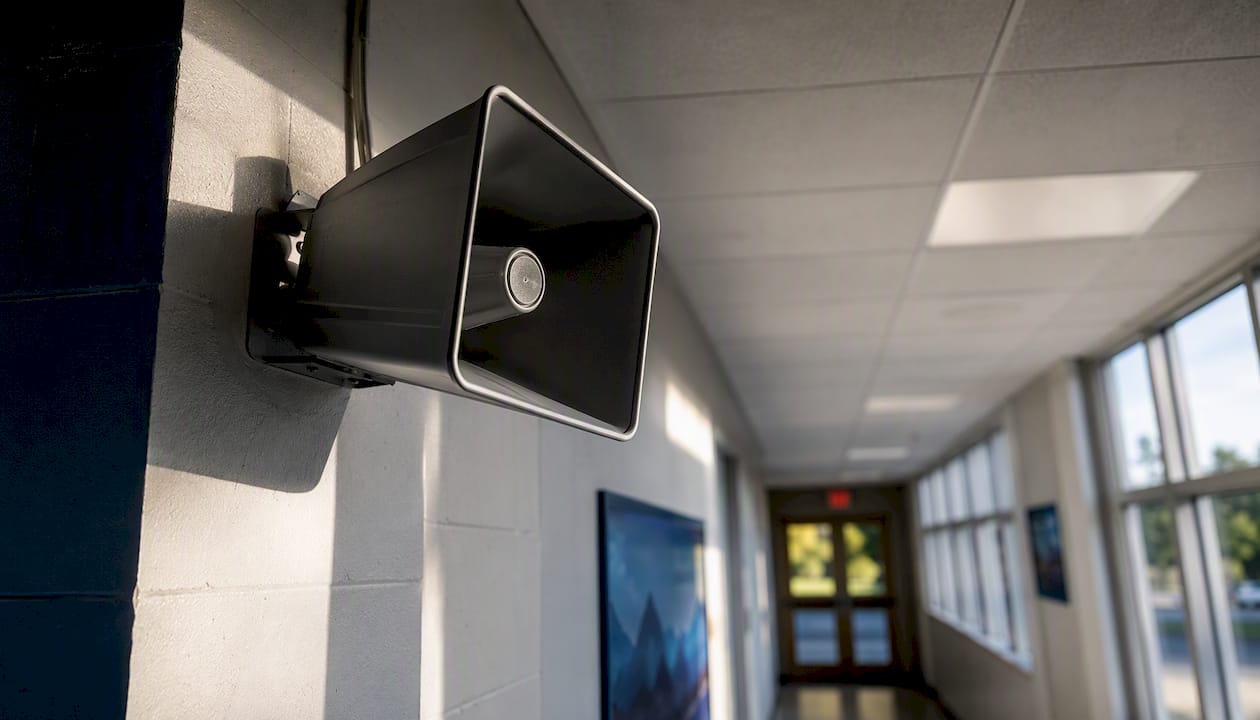
Initiation. The announcement must use the word “lockdown” explicitly, state the action required (“secure your room, lock your door, stay away from windows”), and loop continuously over the PA until the system is confirmed active. Visual alerts should activate simultaneously. Staff who cannot hear the PA, such as those in outdoor areas or portables, must receive the alert through a secondary channel, typically SMS or a wearable device.
All-clear. The all-clear must come from a designated authority, either the principal or law enforcement on scene, and must use a pre-established phrase that staff have practiced in drills. A teacher who hears an unofficial all-clear and opens a classroom door during an active event creates a life-safety risk. The protocol should specify that staff do not open doors until they receive the all-clear through the same channel used for initiation, or until law enforcement physically knocks and identifies themselves using a pre-established code.
Document both announcements verbatim in your crisis response plan and post laminated copies inside every classroom door.
Roles and responsibilities of school staff during a lockdown
Every staff member needs a defined role before a lockdown occurs, not during it.

Principal or designee. Authorizes the lockdown initiation (or confirms an automated trigger), coordinates with law enforcement, and is the sole authority to issue the all-clear. If the principal is unavailable, the chain of command must be documented and practiced.
Safety coordinator. Monitors the access-control console and camera feeds to track threat location, relays verified information to law enforcement, and documents the event timeline in real time.
Classroom teachers. Lock the classroom door (or confirm the electrified lock has actuated), move students away from windows and doors, take attendance, and communicate status to the office via a pre-established signal (a colored card under the door, a text to a designated number).
SRO (School Resource Officer). Coordinates with arriving law enforcement, provides building maps and access credentials, and manages the perimeter until the incident commander takes over.
Substitutes and non-teaching staff. Must complete the same lockdown training as permanent staff. A substitute who does not know the protocol is a gap in the system.
Students. Follow teacher instructions. Age-appropriate lockdown education, delivered without theatrical simulation, helps students respond calmly rather than reactively.
Coordinating with law enforcement and emergency responders during an event
Law enforcement coordination cannot begin at the moment of the event. The relationships, access credentials, and communication protocols must be established in advance.
Before any incident, share building floor plans, access-control override credentials, and camera login information with your local law-enforcement liaison and fire department. Confirm that the PSAP receives structured location data from your system, not just a generic “school emergency” alert. Establish a direct radio or phone channel between the principal’s office and the responding incident commander.
During an event, the safety coordinator’s role is to feed verified camera information to law enforcement without interfering with their tactical decisions. The principal communicates building status (number of students unaccounted for, known threat location) through the pre-established channel. Staff do not communicate with law enforcement directly unless instructed to do so.
After law enforcement declares the scene clear, the incident commander transfers authority back to the principal for the all-clear announcement. This handoff must be explicit and documented.
Post-lockdown procedures and debriefing protocols
The lockdown ending is not the end of the event. Reunification, documentation, and debriefing are all required steps.
Reunification. Follow your district’s student-reunification protocol to release students to verified guardians. This process can take several hours for a large campus and requires a designated reunification site away from the incident area.
Documentation. The safety coordinator should capture a timestamped event log: initiation time, each door’s lock confirmation, PSAP push confirmation, all-clear time, and any system failures observed. This record supports both the post-event debrief and any subsequent grant or insurance documentation.
Debriefing. Within 48–72 hours, convene the planning team (principal, safety coordinator, SRO, IT lead, and a law-enforcement representative if available) to review the event timeline against the documented protocol. Identify every gap: doors that did not actuate, PA coverage failures, staff who did not know the protocol, or communication breakdowns with law enforcement. Assign corrective actions with owners and deadlines.
Mental health response. Coordinate with school counselors and district mental health resources to support students and staff in the days following the event. A lockdown, even one with no physical harm, is a traumatic experience for many occupants.
How lockdown systems affect daily school operations
A well-designed lockdown system should be nearly invisible on a normal school day. The access-control infrastructure that supports a lockdown also manages visitor screening, bell schedules, and after-hours access, so the daily operational benefit is real. School visitor management and access control covers how these functions share the same hardware layer.
The risks to daily operations come from poor design choices. A fail-secure lock on a classroom door that loses power during a routine outage traps students inside. A panic button placed where it can be accidentally activated by a student creates false-alarm fatigue that erodes staff confidence. A mass-notification platform that sends test alerts to staff phones at 7:00 AM on a Saturday generates complaints that lead administrators to disable the system.
Design decisions that minimize disruption: use fail-safe locks on classroom doors, place initiation devices in staff-only locations, build a test mode into the platform that does not trigger PSAP push, and schedule drills during periods that minimize instructional disruption. The goal is a system that staff trust enough to use correctly under stress.
Useful resources and standards to consult
- PASS Safety and Security Guidelines (6th ed.): the primary reference for drill cadence, layered security design, and procurement criteria for K-12 schools
- CISA K-12 School Security Guide (3rd ed.): federal guidance on layered security, electrified hardware alignment, and responder access requirements
- NASP Best-Practice Guidance for School Safety and Lockdown Drills: covers standardized drill design, trauma-informed approaches, and staff training hierarchy
- MOSS Alyssa’s Law Solution Guide (2026): technical specifications for panic-alert systems and PSAP integration aligned to Alyssa’s Law requirements
- National K-12 School Security Minimum Standard Recommendations (LA Safe Schools): defines minimum initiation points, simultaneous actions, and visual alert requirements
- ASTM F3561: the technical standard for door and glazing hardening; reference when writing specifications for new construction or major retrofits
- Your local AHJ and fire department: required consultation for fail-safe vs. fail-secure specifications and egress compliance before any electrified hardware is installed
YDA Security Systems NYC: licensed school security installation in NYC
Schools in Manhattan, Brooklyn, Queens, and Staten Island that need a licensed, insured contractor to design and install their school lockdown systems can work directly with YDA Security Systems NYC. We conduct full site surveys, map every door and its hardware requirements, install electrified locks and commercial-grade door hardware, wire panic initiation devices, integrate access-control panels with mass-notification platforms, and install CCTV systems for threat verification. Every installation includes commissioning documentation, as-built wiring diagrams, and a training handover session for your safety team.
With over 5,000 satisfied clients and a 1-year warranty on installations, YDA Security Systems NYC brings the technical depth and local code knowledge that school security projects require. Contact us to schedule a site survey and receive a scoped proposal for your campus.
Sources
School safety upgrades are capital expenditures, and most districts cannot fund them from operating budgets alone.
- PASS Safety and Security Guidelines (6th ed.)
- CISA K-12 school security guide (3rd ed.)
- National K-12 School Security Minimum Standard Recommendations (LA Safe Schools)
- MOSS Alyssa’s Law Solution Guide (2026)
- Detection-to-Lockdown Architecture (IntelliSee Intelligence briefing)
- Pew Research: About 1 in 4 US teachers say their school went into a gun-related lockdown (2024)
Procurement best practices:
FAQ
What are the different types of lockdowns used in schools?
The most common types are full building lockdown (all doors secured, no movement), geographic/targeted lockdown (only the affected zone secured), secure/hold (exterior doors locked, interior movement continues), and shelter-in-place (occupants move to interior rooms, typically for hazmat or weather events). Each type maps to a different threat scenario and activates different components of the security system.
What does a level 3 lockdown mean in a school?
Lockdown levels are not standardized nationally; individual districts and states define their own tiered systems. A “level 3” in one district may mean a full building lockdown with exterior perimeter secured, while in another it may indicate an elevated threat with partial restrictions. Administrators should confirm their district’s specific definitions and ensure all staff are trained on the local terminology.
How often should schools conduct lockdown drills?
PASS Safety and Security Guidelines recommend standardized lockdown drills at least twice per year, with law-enforcement participation at least once every two years. Drill results should be documented and reviewed to identify system or protocol gaps.
Are school lockdowns actually common?
Pew Research reported in 2024 that about 1 in 4 U.S. teachers said their school went into a gun-related lockdown during the prior school year, indicating that lockdowns occur with measurable frequency in a significant share of districts, particularly in certain regions.
What is the minimum a school lockdown system must include?
At minimum, a system needs at least one lockdown initiation point, simultaneous notification to 911 and building occupants, electrified door locks on all classroom and exterior doors in the lockdown zone, and a documented responder access procedure. The national minimum-standards document also recommends blue-light visual alerts and looped PA announcements as baseline requirements.