
Technology is the central enabler of modern business security. It converts fragmented, standalone controls into an integrated, data-driven security platform that security managers can actually measure and act on. Before you read further, here are three things to prioritize right now:
- Converge cyber and physical security under shared governance. CISA recommends this as the single most effective way to eliminate the gaps that siloed teams create.
- Fix the foundations first. Identity management, asset inventory, network segmentation, and structured cabling must be in place before you layer on AI or cloud analytics.
- Adopt AI and edge capabilities in phases. Pilot on your highest-consequence zones, prove ROI, then scale. YDA Security Systems NYC deploys this phased approach across Manhattan, Brooklyn, Queens, and Staten Island commercial properties every day.
Table of Contents
- How did business security evolve from isolated devices to a strategic asset?
- What are the core technologies that make up modern business security?
- How do you integrate physical and cyber security into one architecture?
- What fundamentals must be in place before deploying advanced security tech?
- What measurable benefits and KPIs should you track after deployment?
- What risks should you anticipate when deploying modern security technology?
- How do you choose a vendor and deployment model?
- How YDA Security Systems NYC approaches integration for a commercial property
- Key Takeaways
- What YDA Security Systems NYC offers security managers in NYC
- Useful sources and further reading
- FAQ
How did business security evolve from isolated devices to a strategic asset?
Not long ago, a business’s security program meant analog cameras recording to a local DVR, a keyed lock on the server room door, and a separate IT team managing the firewall. Those functions rarely spoke to each other, and the gaps between them were exactly where incidents occurred.
The shift happened in stages: analog systems gave way to IP cameras and cloud-managed access control, then on-device AI analytics arrived, and now the industry is moving toward fully converged cyber/physical architectures. CISA and ISC guidance formalizes this trajectory, recommending that organizations merge their Risk Management Framework (RMF) and Risk Management Plan (RMP) processes so that physical and cyber risk assessments align.
The strategic implication is significant. Security is no longer just a cost center. Integrated systems now contribute to operational intelligence and property value, supporting energy optimization, tenant retention metrics, and even insurance defensibility. Executives who once approved security budgets reluctantly are now asking security managers for data dashboards.
Market signal: Edge-based security system shipments are steadily increasing, driven by demand for real-time on-device analytics that reduce both bandwidth consumption and detection latency.
What are the core technologies that make up modern business security?
Modern business security solutions draw from a layered set of technologies. Each layer addresses a distinct threat surface, and together they form the architecture that security managers need to understand before evaluating vendors.

| Technology | Primary Function | Practical Use Case |
|---|---|---|
| Cloud/mobile access control | Credential management, multi-site visibility | Tenant access provisioning without physical key management |
| CCTV + Video Management System (VMS) | Recording, live monitoring, forensic review | Loss prevention and post-incident investigation |
| On-device (edge) AI analytics | Real-time object/behavior detection | Lobby drawn-weapon detection routed to dispatch |
| Sensors and IoT | Environmental and intrusion monitoring | Door contact sensors, motion detectors, HVAC integration |
| Identity and IAM | User lifecycle, MFA, least-privilege access | Preventing credential-based intrusions |
| SIEM/EDR/log management | Threat correlation, endpoint detection | Correlating badge swipes with network login anomalies |
| PSIM/command-and-control | Unified event management | Single-pane dashboard for multi-system alerts |
| Network infrastructure | Segmentation, VLANs, bandwidth | Isolating camera traffic from corporate data networks |
| Backup power and resiliency | Continuity during outages | UPS and generator support for critical endpoints |
Access control systems have moved decisively toward cloud-managed and mobile credential platforms, enabling property managers to grant or revoke access remotely without dispatching a technician. CCTV paired with a modern VMS goes well beyond recording: it feeds AI analytics engines that can detect pre-incident behaviors before an alarm is triggered.
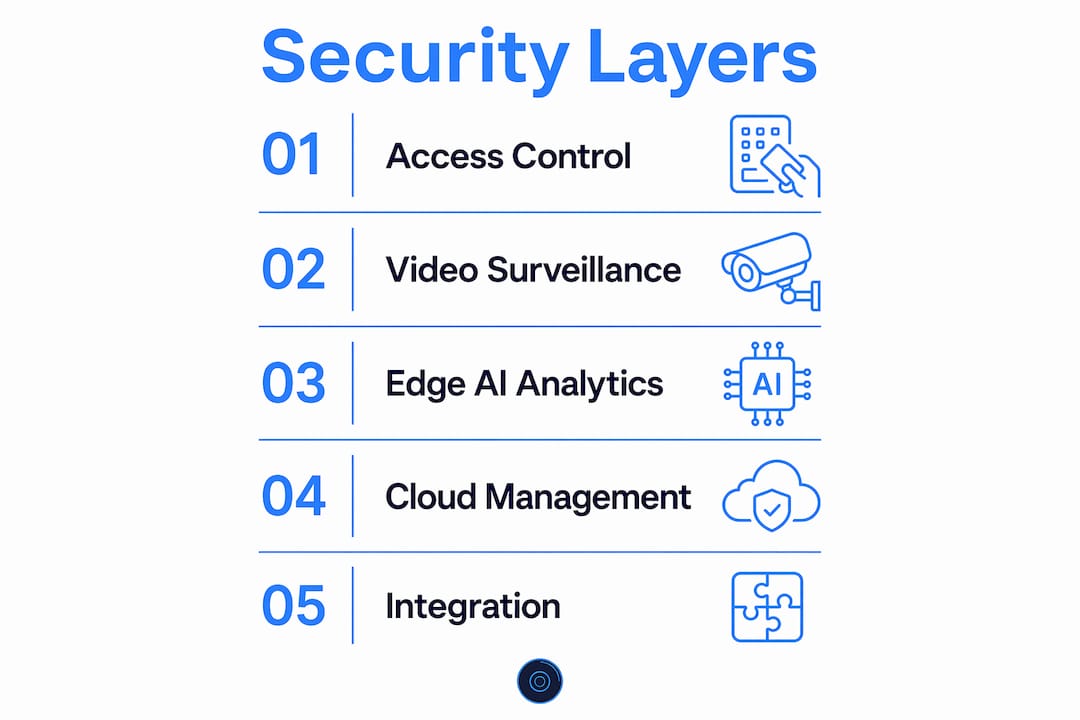
Edge AI analytics are particularly valuable in bandwidth-constrained environments. Processing video on the camera itself rather than sending raw streams to a central server reduces network load and cuts detection latency to near-real-time. A 2026 commercial real estate playbook recommends concentrating AI detection on the highest-consequence zones first, such as lobby entries and loading docks, and routing alerts into existing dispatch workflows.
For properties with legacy analog cameras, retrofitting with AI-enabled gateways is commonly more cost-effective than full camera replacement, while still adding capabilities like license plate recognition and object tracking.
How do you integrate physical and cyber security into one architecture?
The architecture question is where most organizations stall. Three patterns dominate real deployments:
Edge-first places AI inference and local appliances at the device level, keeping sensitive video processing on-premises and avoiding tenant privacy concerns from cloud uploads. This suits high-security environments like financial offices or healthcare facilities.
Cloud-managed centralizes VMS and access control in a hosted platform, giving multi-site operators a single dashboard without maintaining on-site servers. The trade-off is data residency and the need for reliable internet connectivity at every site.

Hybrid combines edge inference for real-time detection with cloud archival and analytics. Most mid-size commercial properties in NYC land here: local appliances handle time-sensitive alerts while cloud storage handles long-term retention and reporting.
Interoperability across these patterns depends on open APIs, event buses, and PSIM platforms that translate alerts from physical devices into SIEM and SOAR workflows. When a forced-entry sensor triggers, the PSIM can simultaneously lock down an access control zone, push an alert to the security operations center, and create a log entry in the SIEM for correlation with network activity. That kind of coordinated response is only possible when physical and cyber systems share a common data layer.
Pro Tip: Assign shared decision rights and integrated SLAs across IT, facilities, and physical security from day one. When cameras are treated as IT endpoints, they get patched and monitored. When they are treated as facilities equipment, they often get ignored until they fail.
CISA’s blended governance model recommends organizational structures ranging from a partial blend (shared meetings and policies) to a fully blended security operations function. Either approach outperforms the traditional silo, where a physical breach and a concurrent network intrusion might be handled by two teams that never speak.
What fundamentals must be in place before deploying advanced security tech?
Advanced technology on a weak foundation creates more risk, not less. KPMG’s cybersecurity technology risk survey confirms that security leaders consistently identify data governance, identity management, and disciplined operational processes as prerequisites before scaling automation or AI.
A phased approach works best:
- Assessment (weeks 1–4): Inventory all physical and cyber assets, map OT/IoT devices, and document existing cabling infrastructure. Identify which cameras are analog, which access control panels are IP-connected, and where network segmentation is absent.
- Foundational fixes (weeks 5–12): Implement network segmentation and VLANs to isolate camera traffic. Enforce MFA and least-privilege identity policies. Audit structured cabling for CAT6 or fiber capacity.
- Pilot (weeks 13–20): Deploy AI analytics and cloud-managed access control in one or two high-value zones. Validate alert routing into SIEM and test incident response procedures.
- Scale (weeks 21–36): Roll out across remaining zones with staff training and updated SOPs.
- Sustain: Establish SLAs for patching, firmware updates, and remote monitoring.
Pro Tip: Audit your structured cabling and power resiliency before deploying HD video or on-device AI. Many deployments underperform because existing CAT5 wiring cannot sustain the throughput that 4K cameras and AI gateways demand. Upgrading to CAT6 or fiber at this stage is far less expensive than troubleshooting bandwidth bottlenecks after installation.
Cost brackets vary by site size. A small single-site deployment (assessment through pilot) typically runs in the low five figures. A mid-size commercial property with multiple access points and a VMS upgrade will land in the mid-to-upper five figures. Multi-site commercial portfolios should budget for six-figure programs spread across 12–24 months, with phased capital expenditure aligned to lease cycles or renovation windows.
What measurable benefits and KPIs should you track after deployment?
The business case for modern security technology is strongest when you define KPIs before deployment, not after. Key metrics to track include:
- Incident detection time: How quickly does the system identify a threat from the moment it begins?
- False positive rate: High false positive rates erode operator trust and slow response.
- Mean time to respond (MTTR): From alert to physical or cyber response action.
- Guard hours saved: Automated monitoring reduces the need for manual patrol rounds.
- Shrink and theft reduction: Measurable in retail and warehouse environments.
- Tenant satisfaction and retention: Documented in commercial real estate as a direct outcome of visible, well-managed security.
- Critical endpoint uptime: Percentage of cameras, access panels, and sensors online at any given time.
Integrated systems also contribute to insurance defensibility. Deployments that document AI detection procedures can influence insurance renewals and strengthen litigation defensibility when incidents occur. For property managers, that translates directly to reduced liability exposure. Managed service models, including video-as-a-service and monitoring-as-a-service, convert capital expenditures into predictable operating expenses, which simplifies budget forecasting and aligns security costs with revenue cycles.
What risks should you anticipate when deploying modern security technology?
Every technology layer introduced into a security architecture also expands the attack surface. Understanding these risks before deployment is what separates a well-governed program from one that creates new vulnerabilities while trying to close old ones.
- IoT attack surface: IP cameras, smart locks, and environmental sensors are network endpoints. Segment them on dedicated VLANs and enforce firmware update policies to reduce exposure.
- Privacy and biometrics: Facial recognition and behavioral analytics raise legal and ethical considerations, particularly in New York. Adopt privacy-by-design settings, limit data retention, and document consent procedures.
- Supply-chain and firmware risk: Hardware from unvetted manufacturers may carry unsigned firmware or undisclosed backdoors. Require signed firmware and vendor attestations in procurement contracts.
- Vendor lock-in: Proprietary platforms can trap you in a single ecosystem. Prioritize open APIs and vendor-neutral PSIM platforms that allow component substitution.
- Bandwidth bottlenecks: HD video and AI analytics consume significant network capacity. Validate bandwidth availability before deployment and consider edge processing to reduce central network load.
- Organizational siloing: The most common failure mode. Physical security and IT teams operating independently miss correlated threats. CISA’s convergence guidance directly addresses this with recommended governance models.
NIST’s defense-in-depth framework and CISA’s converged risk assessment methodology provide the compliance guardrails that structure these mitigations. Both are referenced in the sources section below.
How do you choose a vendor and deployment model?
The deployment model decision comes first. On-premises systems offer low latency and full data residency control, which matters for regulated industries and high-security environments. Cloud-managed VMS and access control deliver multi-site scalability and eliminate the risk of on-site DVR failure, but they require careful negotiation on data retention periods and exportability clauses. Managed service models offload operational burden entirely, converting capital costs to predictable monthly fees.
When evaluating vendors, ask these specific questions:
- What encryption standards does the platform use for data in transit and at rest?
- What is your firmware update policy, and how quickly are critical vulnerabilities patched?
- Does your platform support open APIs for integration with our existing VMS and access control system?
- What are your SLA uptime commitments, and what penalties apply for breaches?
- How do you handle data retention, and can we export our data if we switch vendors?
- What certifications does your organization hold (SOC 2, ISO 27001, UL Listed)?
Contract terms worth requiring: a minimum 99.9% uptime SLA for cloud-hosted components, a hardware warranty of at least one year, defined response times for critical alerts, and a data portability clause that guarantees access to your recordings and logs upon contract termination. For security system monitoring and maintenance, confirm that the managed service provider documents all maintenance activities and provides monthly reporting against agreed KPIs.
Cloud-based access control platforms deserve particular scrutiny on the identity and access management side. Verify that the platform supports MFA, role-based access control, and automated de-provisioning when employees leave.
How YDA Security Systems NYC approaches integration for a commercial property
A representative commercial deployment by YDA Security Systems NYC illustrates how these principles translate to an actual installation. The project involved a multi-tenant office building in Manhattan requiring a full security upgrade across three floors and a ground-level lobby.
YDA’s licensed technicians began with a structured cabling audit, confirming that existing CAT5e runs in two zones were insufficient for 4K camera streams. Those runs were upgraded to CAT6 before any cameras were mounted, eliminating the bandwidth bottleneck before it could affect performance. The deployment included a cloud-managed VMS with on-device AI analytics at the lobby entry, a cloud-based access control system with mobile credentials for tenant staff, and magnetic locks with door contact sensors on all stairwell and service entries.
The phased timeline ran approximately 14 weeks from assessment to full commissioning. In the first 30 days after go-live, the property manager reported a measurable reduction in unauthorized access attempts, attributed to the combination of mobile credential enforcement and AI-assisted lobby monitoring. All work was completed by licensed and insured technicians, and the installation carries YDA’s standard one-year warranty.
Pro Tip: Concentrate your AI analytics budget on the lobby and loading dock first. Those two zones account for the majority of pre-incident detection opportunities in commercial buildings, and proving ROI there makes the case for expanding coverage to upper floors.
For security managers evaluating the role of technology in modern business security at their own properties, this kind of phased, audit-first approach consistently outperforms rushing to deploy advanced technology on an unverified infrastructure.
Key Takeaways
Technology transforms business security from isolated devices into an integrated, measurable platform only when governance, infrastructure, and phased deployment are aligned from the start.
| Point | Details |
|---|---|
| Converge governance first | Assign shared decision rights across IT, facilities, and physical security before deploying any new technology. |
| Audit cabling and power | Upgrade to CAT6 or fiber before HD video or AI deployment; existing CAT5 wiring frequently bottlenecks performance. |
| Retrofit before replacing | AI-enabled gateways are commonly more cost-effective than full camera replacement and add LPR and object tracking. |
| Pilot AI in high-value zones | Concentrate analytics on lobbies and loading docks first to prove ROI before scaling to full coverage. |
| YDA Security Systems NYC | Provides licensed, warranted installation of VMS, access control, and low-voltage wiring across Manhattan, Brooklyn, Queens, and Staten Island. |
What YDA Security Systems NYC offers security managers in NYC
Security managers in Manhattan, Brooklyn, Queens, and Staten Island who are ready to move from planning to installation have a direct path forward with YDA Security Systems NYC. With over 5,000 satisfied clients and a one-year warranty on all installations, YDA brings licensed, insured technicians to every job, from a single-door access control upgrade to a full multi-floor VMS and low-voltage wiring project.
YDA’s core commercial services cover intercom systems, security camera installation, access control, magnetic locks, door hardware, and structured cabling, all designed to work as an integrated system rather than a collection of independent devices. Every deployment starts with an infrastructure audit, so you know exactly what your cabling and power can support before a single camera is mounted.
Contact YDA Security Systems NYC to schedule a site assessment and get a detailed estimate for your property.
Useful sources and further reading
“Convergence is broader than physical interaction between cybersecurity and IT. Stakeholders have transitioned from only focusing on program-level challenges to incorporating convergence, interoperability, and business operational improvements as critical success components of key initiatives.” — Security Industry Association, Security Convergence 2024
The sources below informed this article and provide authoritative guidance for deeper study:
- CISA: Cybersecurity and Physical Security Convergence — Foundational U.S. government guidance on blending cyber and physical security functions to eliminate organizational gaps.
- CISA/ISC: Security Convergence — Achieving Integrated Security — Detailed framework for merging RMF and RMP processes; includes governance models and shared decision-rights guidance.
- CISA: Blending Cyber and Physical Security Resources — Summit material covering organizational models from partial to fully blended security functions.
- KPMG Cybersecurity Technology Risk Survey — Survey of security leaders on the importance of foundational governance before scaling automation.
- IndexBox: U.S. Intelligent Security System Market — Market analysis covering edge shipment growth rates, retrofit economics, and managed service trends.
- IntelliSee: Commercial Real Estate AI Security 2026 Playbook — Practical guidance on zone-first AI deployment, dispatch integration, and insurance defensibility.
- Terapixels: Integrated Security Systems Implementation Guide — Covers structured cabling requirements, cloud vs. on-prem trade-offs, and contract terms for commercial real estate.
- YDA Security Systems NYC: Integrated Security for Business — Site-specific guidance on converging physical and cyber security for NYC commercial and residential properties.
FAQ
What is the role of technology in business security?
Technology converts standalone security devices into an integrated platform that correlates physical and cyber events, automates alerts, and gives security managers measurable data to act on. CISA identifies this convergence as the most effective way to close the gaps that siloed teams create.
How does technology improve security in a modern business?
Modern security technology improves detection speed, reduces false positives, and enables coordinated responses across physical and cyber domains. Edge AI analytics, cloud-managed access control, and SIEM integration allow a single alert to trigger simultaneous lockdown of doors and network accounts.
What role does technology play in business operations beyond security?
Integrated security systems now contribute to operational intelligence, including energy optimization, tenant retention metrics, and property valuation. Documented AI detection procedures can also influence insurance renewals and strengthen a property’s litigation defensibility.
What are the 5 P’s of security?
Definitions vary across frameworks, but a widely used version in physical security covers People, Policies, Procedures, Physical controls, and Perimeter. These five elements form the governance and operational foundation that technology is designed to support, not replace.
How should a security manager start a technology modernization project?
Start with an infrastructure and asset audit: inventory all physical and cyber endpoints, assess structured cabling capacity, and map network segmentation gaps. YDA Security Systems NYC begins every commercial deployment with exactly this audit to confirm that cabling and power can support the planned technology before installation begins.