
Perimeter security for businesses is defined as the outermost layer of physical and electronic protection designed to deter, detect, delay, and respond to unauthorized access before a threat reaches your building’s interior. The industry term for this integrated approach is “defense-in-depth,” a framework that stacks physical barriers, technical sensors, and administrative controls into mutually reinforcing layers. Standards such as ASCE 7 structural guidelines govern how physical components like fencing and bollards must perform under real-world conditions. For business owners and security managers in Manhattan, Brooklyn, Queens, and Staten Island, understanding this framework is the first step toward building a protection plan that actually works.
What is perimeter security for businesses, and why does it matter?
Perimeter security is the practice of controlling who and what enters your property at its outermost boundary. Its goal is not simply to stop a determined intruder but to slow that intruder long enough for a response to arrive. The security industry formalizes this as the “Deter, Detect, Delay, Respond” framework, and every component of a well-designed system maps to one of those four functions.
The importance of perimeter security becomes clear when you consider what it protects. A business without a defined outer boundary relies entirely on interior locks and alarms, which means a threat is already inside before anyone responds. Perimeter protection pushes that detection point outward, giving security personnel or law enforcement time to intervene. For commercial properties in dense urban environments like New York City, that time advantage is the difference between a contained incident and a serious loss.
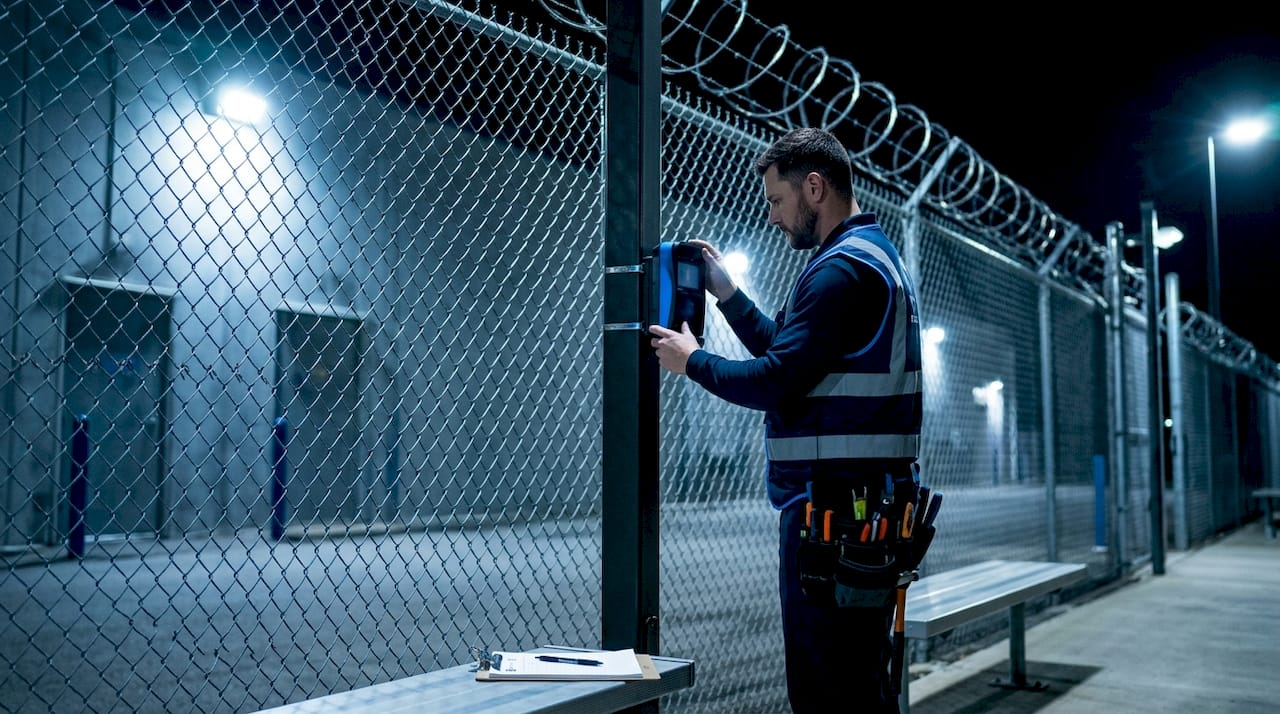
Physical security, the broader discipline that perimeter defense belongs to, also intersects with cybersecurity in ways many business owners overlook. Over 80% of breaches involve a human element, which means no camera or fence alone closes every vulnerability. That statistic points directly to the need for administrative controls alongside physical and technical measures.
What components make up effective perimeter security systems for businesses?
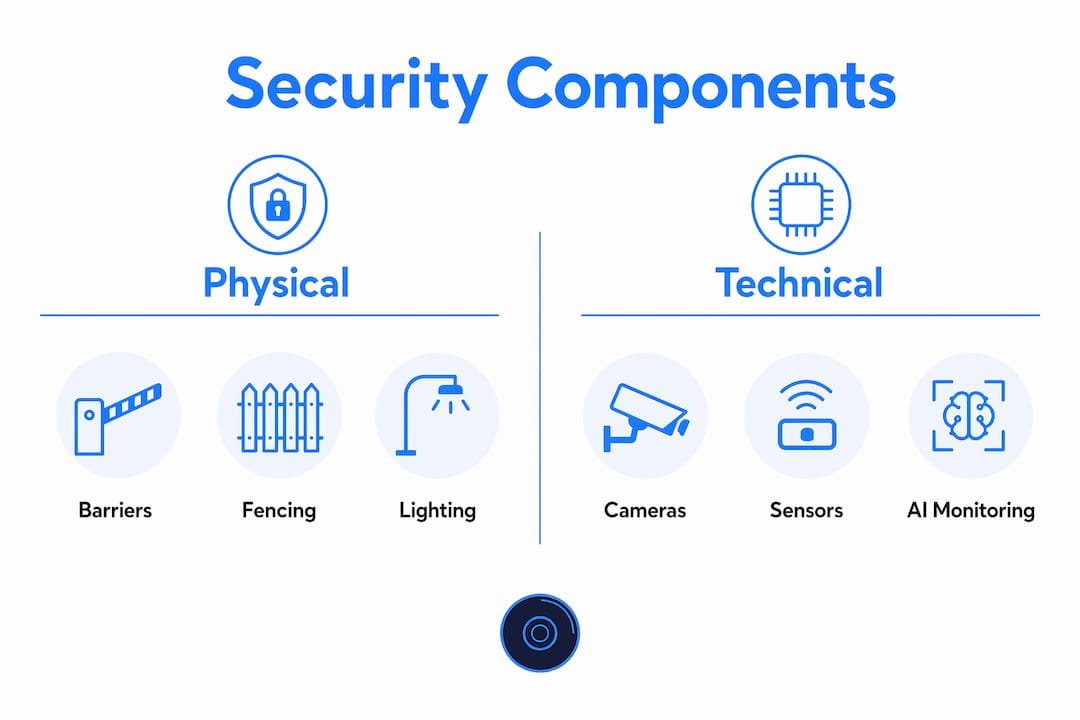
An effective perimeter security system combines three categories of controls: physical barriers, technical solutions, and administrative measures. Each category addresses a different part of the threat picture, and all three must work together.
Physical barriers
Physical barriers form the first line of defense. Standard commercial fencing must reach at least 6 feet in height, with 8–10 feet recommended for higher-security sites. Post embedment depth matters as well: high-wind zones require 36–42 inches of concrete footing, compared to 24 inches in low-wind areas. Beyond fencing, vehicle barriers such as bollards and crash-rated gates prevent ram-raid attacks, which are a real concern for ground-floor commercial properties in busy NYC corridors. Controlled entry gates with card readers or intercom systems add a checkpoint layer that fencing alone cannot provide.
Technical solutions
Technical solutions extend your detection range far beyond what a guard can observe. Motion sensors, AI-assisted cameras, and remote monitoring platforms watch your perimeter continuously. Advanced drone-response systems can verify a perimeter alert within 60–90 seconds, dramatically improving the speed of intervention. AI-driven video analytics reduce false alarms by distinguishing between a person and a passing vehicle, which keeps your security team focused on real threats. For NYC businesses, commercial surveillance setups often combine fixed cameras at entry points with wide-angle coverage across parking areas and loading docks.
Administrative controls
Administrative controls address the human element that physical and technical systems cannot fully cover. Access policies, visitor management procedures, and regular staff training all reduce the risk of insider threats and social engineering. Physical and cybersecurity layers are codependent, and administrative weaknesses at access points account for the majority of security failures. A well-written access policy, reviewed annually and enforced consistently, closes gaps that no camera can see.
Pro Tip: Review your access control logs monthly. Unusual after-hours badge activity is one of the earliest indicators of an insider threat or a compromised credential.
How does a layered defense approach enhance business perimeter protection?
The defense-in-depth model works because no single layer is perfect. Physical, technical, and administrative controls are designed to reinforce each other, so a failure in one layer does not automatically result in a breach. A fence can be cut, but a motion sensor catches the intrusion. A sensor can trigger a false alarm, but AI-assisted human review filters it before a response is dispatched. That mutual reinforcement is what makes layered security fundamentally more reliable than any single measure.
The timing principle behind this model is precise. Cumulative delay produced by layered security must exceed the response time for guards or police to arrive. If your barriers, sensors, and checkpoints together slow an intruder for eight minutes, but your response time is twelve minutes, you have a gap. Effective perimeter defense design calculates that gap and adds layers until the math works in your favor.
Verification is the stage where many systems fall short. Verification of perimeter alerts via AI-assisted human review is the most critical step in reducing false alarms and prioritizing real threats. A system that generates constant false alerts trains your team to ignore warnings, which is exactly the condition an intruder can exploit.
| Approach | Traditional perimeter security | Modern perimeter security |
|---|---|---|
| Detection method | Guard patrols and basic motion lights | AI cameras, sensors, and drone verification |
| Response speed | Minutes to hours depending on patrol cycle | 60–90 seconds with drone dispatch |
| False alarm handling | Manual review, often delayed | AI-assisted filtering before human review |
| Administrative integration | Minimal, often siloed | Unified access policies and digital audit logs |
| Scalability | Limited by staffing levels | Expandable with additional sensors and software |
Pro Tip: When evaluating a perimeter security system, ask vendors to show you their false alarm rate. A system with a high false alarm rate will erode your team’s response discipline within weeks.
What are common types of perimeter security solutions used by businesses?
Business perimeter protection takes many forms depending on property size, threat level, and local regulations. The most effective configurations combine multiple solution types rather than relying on a single measure.
Physical solutions include chain-link and welded-wire fencing for standard commercial sites, ornamental steel fencing for properties where appearance matters, and anti-climb panels for high-security perimeters. Vehicle barriers range from surface-mounted bollards to in-ground hydraulic barriers. Vehicle barrier specifications must account for duty cycle and operation frequency to prevent overheating and mechanical failure during peak usage hours. A loading dock gate that cycles 200 times per day needs a fundamentally different specification than a main entrance gate that opens 20 times per day.
Technological solutions for business perimeter defense include:
- Fixed IP cameras with wide-angle lenses covering fence lines and entry points
- Thermal imaging cameras for low-light or no-light detection
- Microwave and infrared motion sensors along fence lines
- License plate recognition systems at vehicle entry gates
- Remote monitoring platforms with 24/7 human oversight
- Access control systems using key fobs, PIN pads, or biometric readers at controlled gates
Administrative solutions include documented visitor management protocols, security guard post orders, employee training on tailgating prevention, and scheduled perimeter inspections. For NYC commercial properties, security systems tailored to local offices often combine access control at building entries with CCTV coverage of sidewalk-level perimeters, which addresses the unique challenge of high foot traffic in dense urban blocks.
| Solution type | Best use case | Key limitation |
|---|---|---|
| Chain-link fencing | Warehouses, parking lots, industrial sites | Low deterrence value for determined intruders |
| Ornamental steel fencing | Office campuses, retail properties | Higher cost, requires professional installation |
| Hydraulic vehicle barriers | High-traffic commercial entrances | Requires maintenance schedule and duty-cycle spec |
| AI-assisted cameras | All commercial perimeters | Requires reliable network infrastructure |
| Remote monitoring | Properties without on-site guards | Response depends on third-party dispatch speed |
| Access control gates | Controlled entry points | Vulnerable to tailgating without staff training |
How can businesses plan and implement effective perimeter security?
Effective perimeter security design starts before construction or renovation begins. Early integration of perimeter security into project design, rather than treating it as an afterthought, produces systems that are both more effective and less expensive to install. Retrofitting barriers and conduit runs into a finished building costs significantly more than planning for them from the start.
A structured implementation process follows these steps:
- Conduct a formal site threat assessment. Identify your property’s vulnerabilities, including unlit areas, unsecured gates, and high-traffic entry points. Document the findings and use them to prioritize spending.
- Review local regulations. NYC zoning laws, building codes, and wind-load standards all affect what you can install and how it must be built. Fencing height restrictions vary by borough and zoning district.
- Define your performance requirements. For active components like vehicle barriers, specify the required duty cycle, operating temperature range, and cycles per hour before selecting a product. Matching the specification to actual usage prevents premature failure.
- Layer your controls deliberately. Map each planned measure to one of the four functions: deter, detect, delay, or respond. If any function has no coverage, add a control to fill that gap.
- Build a verification and response plan. Decide in advance who reviews alerts, how they escalate confirmed threats, and what the expected response time is. Then test that plan with a tabletop exercise before going live.
Upgrading your security systems also means integrating perimeter controls with interior measures. A perimeter camera system that does not feed into the same monitoring platform as your interior access control creates blind spots in your audit trail. Integration produces a single, coherent picture of activity across your entire property.
Pro Tip: After installation, walk your perimeter at night with a flashlight. Lighting gaps, camera blind spots, and unsecured fence sections are far easier to identify in person than on a site plan.
Key Takeaways
Effective perimeter security for businesses requires physical barriers, technical detection systems, and administrative controls working together, with cumulative delay exceeding your security team’s response time.
| Point | Details |
|---|---|
| Defense-in-depth is the standard | Layer physical, technical, and administrative controls so failure in one layer does not cause a breach. |
| Fencing height standards matter | Commercial fencing requires at least 6 feet in height, with 8–10 feet for higher-security sites. |
| Verification reduces false alarms | AI-assisted human review of alerts is the most critical step in any perimeter security workflow. |
| Vehicle barriers need duty-cycle specs | Match barrier specifications to actual usage cycles to prevent mechanical failure at peak hours. |
| Early design integration saves money | Planning perimeter security before construction is complete reduces retrofit costs significantly. |
YDA Security Systems NYC: Perimeter Security for Your Business
YDA Security Systems NYC designs and installs perimeter security solutions for commercial properties across Manhattan, Brooklyn, Queens, and Staten Island. Our licensed and insured technicians handle security camera installation, access control, intercom systems, and commercial door hardware, all backed by a 1-year warranty on installations. We have served over 5,000 clients across New York City, and we bring that experience to every site assessment and installation. Whether you manage a single retail location or a multi-building campus, our team configures systems that match your specific threat profile and local code requirements. Contact YDA Security Systems NYC to schedule a site assessment and get a perimeter security plan built for your property.
FAQ
What is perimeter security for businesses?
Perimeter security for businesses is the outermost layer of physical and electronic protection that deters, detects, delays, and responds to unauthorized access. It combines fencing, barriers, cameras, sensors, and access controls into an integrated defense system.
How does the defense-in-depth model work?
Defense-in-depth stacks physical, technical, and administrative security layers so that each one compensates for weaknesses in the others. The goal is to ensure the total delay time across all layers exceeds the time needed for a security response to arrive.
What fence height is required for commercial perimeter security?
Standard commercial perimeter fencing must be at least 6 feet high, with 8–10 feet recommended for higher-security sites. Post embedment depth must also meet structural requirements, particularly in high-wind zones.
Why is alert verification so important in perimeter security?
Verification distinguishes real threats from false alarms, which is critical because a high false alarm rate causes security teams to deprioritize alerts. AI-assisted human review is the most effective method for accurate, fast verification.
How do businesses in NYC approach perimeter security differently?
NYC commercial properties face unique challenges including high pedestrian traffic, dense building layouts, and borough-specific zoning restrictions on fencing and barriers. Effective commercial security in Brooklyn, Manhattan, and Queens typically combines sidewalk-level CCTV, controlled entry intercoms, and access control systems tailored to urban building configurations.