
If a maglock won’t release, the first priority is confirming safe egress and avoiding force against the door. Then, work through four likely areas: power at the lock terminals, wiring polarity, mechanical contact between the armature and magnet face, and fire alarm interlocks holding the lock closed. Most stuck maglocks trace back to one of these, and a licensed technician should be called when fire alarm systems or unknown battery backups are involved.
TL;DR:
- Voltage should be measured under load, as a normal reading at idle does not guarantee sufficient power during operation.
- Mechanical contact issues from misalignment or missing washers can mimic electrical faults and prevent proper lock release.
- Switching the negative conductor instead of the positive at the controller can cause delays or prevent the lock from releasing immediately.
- Fire alarm interlocks and local battery backups can keep the lock engaged even when the fire alarm panel itself is powered, requiring careful verification.
- Licensed technicians should handle complex diagnoses involving fire alarm systems, unknown battery systems, and wiring documentation to ensure code compliance and safety.
Table of Contents
- Quick troubleshooting checklist to run first
- Measuring voltage and current to catch power supply problems
- Mechanical causes: armature contact, washers, and mounting
- Wiring and control logic that can hold a lock engaged
- Fire alarm and code-related reasons a maglock stays locked
- When to call a licensed access control technician
- Get code-compliant maglock repair from YDA Security Systems NYC
- Sources
- FAQ
Quick troubleshooting checklist to run first
Before opening panels or pulling wiring diagrams, run through a short sequence that isolates the obvious causes in minutes.
- Confirm the door has a safe secondary exit path and do not force the locked door.
- Check for power at the lock terminals and note the voltage reading.
- Listen for a faint hum, which usually indicates power is present but contact is poor.
- Inspect the armature plate and magnet face for dust, paint overspray, or misalignment.
- Check wiring connections for looseness and confirm which conductor the controller switches.
- Look for a diode or surge suppressor wired across the lock leads.
- Check the controller for lit LEDs, active relays, and any programmed time-delay settings.
- Note any recent work on the door, panel, or fire alarm system that preceded the failure.
Each of these checks takes seconds and rules out the most common culprits before deeper diagnostics begin.
Measuring voltage and current to catch power supply problems
A maglock that reads normal voltage while idle can still fail to release once load is applied, so testing under load matters more than a static reading. Set a multimeter to DC and measure directly at the lock leads, expecting either 12V or 24V depending on how the unit was specified.
- Compare the reading at the power supply output against the reading at the lock terminals to catch voltage drop from wire gauge or run length.
- A drop of more than roughly 10% between supply and lock under load usually points to undersized wiring or a run that exceeds the supply’s rated distance.
- Shared loads, such as a maglock and an electric strike on the same supply, increase total current draw and can push a marginal supply past its limit.
- Inrush current at power-up is higher than steady-state holding current, which is why a supply that seems adequate at rest can still struggle.
Typical maglock current draw ranges are documented in installer references, and adding a second locking device or panic hardware to the same circuit increases the load enough to create power-supply issues, according to industry troubleshooting coverage from an access control expert. The same source notes that voltage should be measured under load rather than at idle, since an unloaded reading can look correct while the supply still cannot sustain the magnet once it draws full current. A local battery backup at the door power supply can also keep the lock energized even after the upstream breaker or panel loses power, which explains why a lock stays engaged when someone assumes power has been cut.
Mechanical causes: armature contact, washers, and mounting
A maglock is only as strong as the physical contact between the armature plate and the magnet face, and misalignment often looks identical to an electrical fault from the outside. If the plate sits even slightly off-center or the mounting is too rigid, holding force drops and the lock can seem to grab or fail to seat properly.
- The armature plate must float on its mounting so it can self-align against the magnet face when the door closes.
- Rubber gaskets or spacers cushion the plate and allow that floating motion; missing or crushed washers are a frequent cause of reduced holding force.
- Overtightening the center set screw locks the plate rigid and prevents it from finding full contact, which mimics a power or wiring fault.
- The fix is usually to loosen the set screw slightly, let the plate re-center against the magnet, reinstall correct washers or spacers, then retest before final torque.
Allegion’s LCN SEM 7840 and SEM 7850 series installation instructions walk through correct magnet and armature mounting and stress testing contact with power applied rather than assuming alignment from a visual check alone.
Pro Tip: Energize the lock before final tightening and try to twist the armature plate slightly by hand. If it moves at all, the plate has not seated fully and needs re-centering before you torque it down.
Wiring and control logic that can hold a lock engaged
Interrupting power to a maglock only releases it instantly when the controller switches the positive DC line. Switching the negative conductor instead is a documented installation mistake that delays or prevents release even though the circuit appears open.
- Confirm which lead the controller actually switches by tracing the wiring diagram, not just by assumption.
- Check for a diode, flyback suppressor, or capacitor across the lock leads, since these components can slow the voltage drop enough to delay release by a noticeable margin.
- Review the controller’s programmed relock delay, since many boards default to a short delay that can look like a stuck lock during testing.
- As a diagnostic step, momentarily interrupt the DC positive feed directly at the lock supply to see whether the lock drops immediately, which isolates a lock problem from a controller or programming problem.
Schlage’s M390/390-2 DEL installation and programming instructions specifically warn that switching the negative line will not allow immediate release and list armature washers, low-voltage alerts, and relock timing among the standard troubleshooting checkpoints.
Fire alarm and code-related reasons a maglock stays locked
Some maglocks stay engaged on purpose, and that is not a fault. Codes generally require magnetic locks to release automatically on loss of power at the fire alarm control panel (FACP), but a separate local power supply at the door, especially one with its own battery backup, can keep the door locked even after someone cuts power at that local supply.
- Confirm FACP status first: if the panel still has power, an interlocked lock may stay secured by design.
- Check whether the local door power supply has a battery backup that is still holding the lock energized independent of the panel.
- Review any allowed delay egress or annunciation settings that could explain a lock that seems slow to release rather than truly stuck.
- Never attempt permanent changes to a fire alarm interlock without coordinating with the fire alarm technician or the authority having jurisdiction.
Fire life safety reporting on lockup issues explains that this exact scenario, where an inspector or technician isolates only the local door supply while the FACP still has power, is a common source of confusion during troubleshooting.
When to call a licensed access control technician
Some of the checks above are safe for on-site staff to run. Others cross into work that should go to a licensed low-voltage contractor, particularly anything touching fire alarm interlocks or unknown battery systems.
- Call a technician when the lock fails to release even after momentarily interrupting DC positive at the supply.
- Call a technician when FACP status is unclear or the interlock wiring has not been documented.
- Call a technician when current draw seems marginal across multiple devices sharing one supply.
- Call a technician when armature remounting does not restore full contact after reasonable adjustment.
Technicians handle exactly these diagnostics on-site: voltage-under-load testing, relay and controller programming review, FACP and ACP interconnect verification, and proper armature remounting with contact testing. For buildings evaluating whether a maglock or a different locking approach fits the door better, our breakdown of magnetic lock vs electric strike options is a useful next read, and our access control system checklist covers the preventive maintenance that keeps these failures from recurring.
Get code-compliant maglock repair from YDA Security Systems NYC
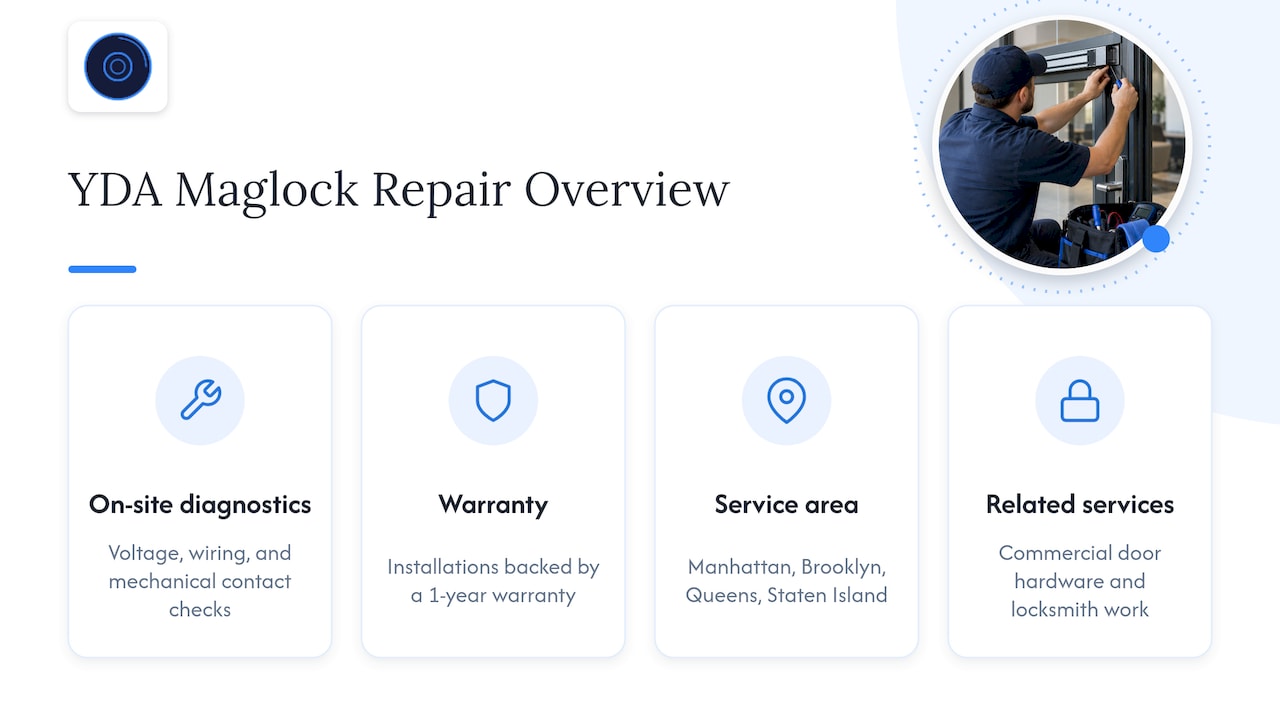
A stuck maglock is rarely a simple fix once fire alarm interlocks or unknown battery backups are part of the picture, and getting it wrong risks either a security gap or a code violation. Licensed and insured technicians diagnose voltage, wiring, and mechanical contact issues on-site and correct them without guesswork, with installations backed by a 1-year warranty.
Property managers across Manhattan, Brooklyn, Queens, and Staten Island call us for exactly this kind of troubleshooting, along with related work like commercial door hardware and locksmith services when armature or frame corrections are needed. If your maglock is holding, delaying, or releasing unpredictably, book an access control repair visit and get a technician on-site with the right tools and documentation for your specific hardware.
FAQ
Can door magnets fail to release?
Yes. A maglock can fail to release due to loss of power at the wrong point in the circuit, the controller switching the negative conductor instead of positive, misaligned armature contact, or a fire alarm interlock intentionally holding the door secured.
How do you unlock a maglock?
Confirm safe egress first, then interrupt the DC positive feed at the lock’s power supply, which should cause an immediate drop if the wiring and controller are functioning correctly. If the lock does not release after that test, the issue is likely mechanical contact or a fire alarm interlock rather than a simple power cut.
What could be the reasons why my magnetic door lock isn’t working?
The most common reasons are incorrect wiring polarity, where the negative rather than positive conductor is switched, poor armature-to-magnet contact from missing washers or overtightening, insufficient power supply capacity under load, and fire alarm control panel interlocks holding the lock engaged by design. Environmental factors like humidity, dust, or temperature swings can also degrade contact over time.
How to release a magnetic door lock?
Interrupt the DC positive conductor at the lock’s power supply and check for an immediate release, which confirms the lock itself is functioning. If it does not drop, check the fire alarm control panel status and any local battery backup, since these can legally keep the door locked independent of the local supply switch.