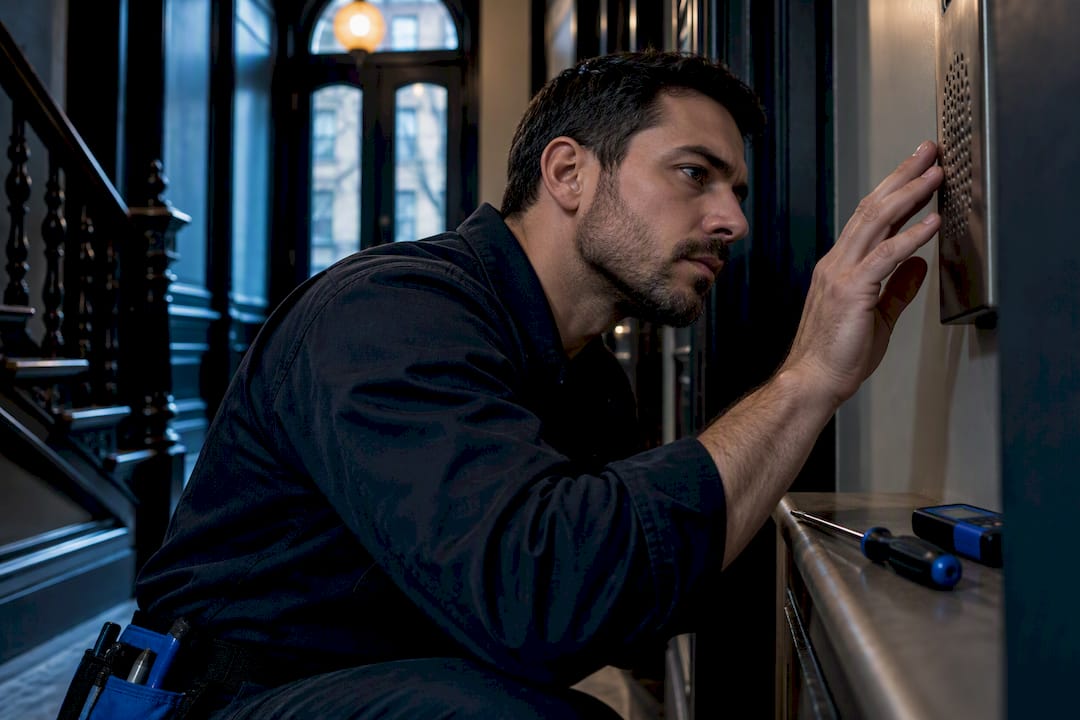
Most elevator camera installation projects succeed or fail on the transmission path, not the camera itself. The best practice is to run video over the existing traveler cable using media converters (Ethernet-over-2-wire or PoE-over-coax), or to specify purpose-built Cat5e-equivalent or fiber traveling cable when the shaft allows it. Reserve wireless or optical links for cars without usable conductors. Keep the system video-only unless counsel confirms audio is legal, and always coordinate the work with the elevator maintenance contractor and your local authority having jurisdiction before anyone touches the car top.
TL;DR:
- Using existing traveler cable with media converters provides a quick, cable-compatible solution, but fiber or Cat5e-equivalent cables offer higher bandwidth for multiple cameras or high-rise buildings.
- Proper camera mounting height is around 8 feet with a 2.8mm lens for standard passenger cars, and 1080p resolution is now considered the baseline for identification clarity.
- Power should be delivered via PoE over media converters, avoiding reliance on restricted elevator service outlets, and should include a backup power solution like a small UPS for reliability.
- Video-only recording is generally permitted, but audio recording is restricted by wiretapping laws unless explicitly legal in the jurisdiction; height-based mandates also require live video communication for taller elevators.
- Coordinating installation with elevator vendors and conducting a detailed site survey ensures compliance, prevents warranty voidance, and minimizes delays and costly callbacks.
Table of Contents
- Elevator Surveillance Camera Setup: Comparing Transmission Methods
- Where Should Elevator Camera Placement Go in the Car?
- Powering Elevator Cameras: PoE and Service Outlet Limits
- Is It Legal to Have a Camera in an Elevator?
- Coordinating With the Elevator Contractor: Timeline and Budget
- Installer Checklist for Elevator Camera Installation
- Troubleshooting Elevator Monitoring Solutions After Install
- Why Work With a Licensed Low-Voltage Integrator
- Wiring Best Practices Inside the Elevator Shaft
- How Cab Lighting Affects Elevator Surveillance Camera Selection
- Integrating Elevator Cameras With Control and Alarm Systems
- Network Security for Elevator Camera Systems
- Get an Elevator Camera Installation Site Survey
- Sources
- FAQ
Elevator Surveillance Camera Setup: Comparing Transmission Methods
The transmission path decides whether an elevator camera setup runs reliably for a decade or fails within a year. Every method below has a place, but the right choice depends on what’s already inside the traveler cable and how tall the building is.
Traveler cable with media converters. If the existing traveling cable has spare coax, shielded twisted pair, or unused conductors, a media converter pair (one at the car top, one in the machine room) can push Ethernet over those wires without pulling new cable. This is the most common retrofit approach because it avoids opening the hoistway. Ethernet-over-2-wire, sometimes called NVT after the network video transmitter category of products, typically delivers enough bandwidth for a single H.264 or H.265 camera stream and can carry Power over Ethernet back to the car-mounted unit, which eliminates the need for a separate power source inside the cab.
Purpose-built Cat5e-equivalent or fiber traveling cable. For high-rise buildings or installations feeding multiple cameras per car, travel-rated Cat5e-equivalent conductors and fiber options built for elevator flex cycles outperform retrofitted media converters. These meet NEC conductor gauge and flex-rating requirements specifically for traveling cable applications, and fiber sidesteps electromagnetic interference entirely, which matters in shafts running near high-voltage machine room equipment.
Wireless AP pairs and optical transceivers. When no traveling cable path exists and running new cable isn’t feasible, dedicated wireless access point pairs or laser-based optical transceivers can bridge the car-to-hoistway gap. Installers generally treat these as a last resort because shaft dust, misalignment, and RF interference from elevator machinery degrade signal quality over time, and both technologies demand periodic realignment that a coax or fiber link never needs.
- Traveler cable with media converters: fastest retrofit, works with existing wiring
- Fiber or Cat5e-equivalent traveling cable: best for high-bandwidth or multi-camera cars
- Wireless AP pairs: viable fallback, higher maintenance burden
- Optical transceivers: line-of-sight required, sensitive to dust and vibration
Where Should Elevator Camera Placement Go in the Car?
Camera form factor and mounting position determine whether footage is usable evidence or just a blurry record that someone was present. A mini-dome mounted flush to the ceiling blends into most cab interiors and resists tampering better than a corner-mount unit, though corner mounts sometimes provide a wider unobstructed sightline toward the doors in narrow cars.
Resolution needs to be matched to pixels-per-foot, not just marketing specs. Field testing in a typical 8×8 foot cab shows that mounting a wide-angle camera roughly 8 feet high provides identification-grade pixel density even at 720p in many practical cases, while 1080p adds meaningful margin for facial identification and license-worthy detail on smaller objects like packages or tools. For most commercial elevator surveillance camera setups, 1080p has become the practical baseline given how little it adds to bandwidth and storage cost over 720p.
Lens selection follows from car geometry. A 2.8mm wide-angle lens usually covers the full door-to-rear-wall span in a standard passenger cab, while tighter lenses (4mm or above) suit larger freight cars where you need to resolve detail at greater distance rather than maximize coverage width.
- Mount height: approximately 8 feet, corner or ceiling center
- Lens: 2.8mm for standard passenger cabs, 4mm+ for freight or oversized cars
- Housing: vandal-resistant, polycarbonate or metal dome rated for enclosed-space impact
- Finish: choose a housing color that matches the cab interior for a discreet, non-intrusive install
Pro Tip: Order a smoked or tinted dome bubble rather than a clear one. It cuts glare from cab ceiling fixtures and makes the lens angle harder for a passenger to read, without reducing image quality.
Powering Elevator Cameras: PoE and Service Outlet Limits
Power delivery inside an elevator car is more constrained than most security professionals expect walking in. Many cabs have a car-top service outlet, but that outlet is often restricted by the elevator code or the maintenance contract to elevator-related equipment only, not to third-party devices plugged in without documented approval.
When Ethernet isn’t already present at the car top, a media converter with PoE output solves both the data and power problem in a single device, since the converter draws from a dedicated circuit in the machine room and delivers both signal and power over the traveler cable pair. Local PoE injectors mounted in a code-compliant enclosure at the car top are the fallback when a converter isn’t practical, but they still need a verified, listed power source rather than an opportunistic tap off the service outlet.
For cars where no reliable power path exists, battery-backed or cellular-connected camera units can bridge the gap temporarily, though these should be treated as an interim measure rather than a permanent solution given their limited runtime and higher failure rate in a cycling, vibrating environment.
- Prefer PoE delivered through a media converter over the existing traveler cable
- Never plug camera equipment into the service outlet without documented elevator contractor and AHJ approval
- Use a dedicated, listed circuit or an installer-installed injector in an enclosed housing
- Add a power-loss alarm at the monitoring station so an outage on the elevator circuit doesn’t go unnoticed for days
- Consider a small UPS at the machine-room converter to ride through brief power interruptions without dropping the feed
Is It Legal to Have a Camera in an Elevator?
Video surveillance inside an elevator cab is generally allowed in the United States because passengers don’t have a reasonable expectation of privacy in a shared, enclosed public-access space. Audio is a different matter entirely. Federal and state wiretapping statutes impose much stricter consent requirements on audio capture than on video, which is why the near-universal industry practice is to disable the microphone on any elevator camera unless legal counsel has specifically confirmed that audio recording is lawful in that jurisdiction and building type.
ASME A17.1-2019 raised the stakes for anyone planning a new install or a modernization project. The code introduced a two-way video communication requirement for elevators with a rise of roughly 18 meters, about 60 feet or five floors, meaning taller buildings must provide live video between the car and authorized personnel monitoring the system.
Where this provision has been adopted by the local jurisdiction, retrofit costs to bring an existing elevator into compliance typically run $5,000 to $10,000 per car, depending on whether usable wiring already exists or new traveling cable and monitoring integration are required.
Operational policy matters as much as the hardware. Post signage disclosing video surveillance, keep retention windows in a defined 30 to 90 day range, encrypt stored footage, and log every access request with a named requester and reason. Our guide to NYC apartment camera requirements covers tenant notification and placement rules that apply directly to residential elevator installs.
- Operate video-only by default; disable audio unless counsel confirms otherwise
- Check whether your jurisdiction has adopted ASME A17.1-2019’s video mandate for cars over ~60 feet of rise
- Post visible signage disclosing video surveillance
- Set a documented retention window, typically 30 to 90 days
- Maintain encrypted storage and a written access log for footage requests
Coordinating With the Elevator Contractor: Timeline and Budget
Elevator vendor coordination isn’t optional. Only a certified elevator technician can put a car into service mode or authorize car-top access, and modifying an existing traveling cable without the vendor’s involvement can void the elevator’s service warranty. Build vendor scheduling time into every quote from the start.
- Single-car retrofit using existing conductors: typically a one-day install once the elevator contractor schedules service-mode access.
- Multi-car or new traveling cable projects: several days to a few weeks, since hoistway work and machine-room terminations require sequential vendor visits.
- Budget planning: expect roughly $5,000 to $10,000 per car for ASME-driven retrofits, with costs pushed toward the high end by new traveling cable, integration with emergency communication systems, or cellular backhaul for live remote monitoring.
Installer Checklist for Elevator Camera Installation
A structured survey-to-commissioning sequence keeps a project compliant and prevents the callback that comes from skipping a step.
- Survey: inspect traveling cable conductors, confirm car-top power availability, check ASME A17.1-2019 applicability, and get written elevator vendor signoff before scheduling work.
- Install: mount the camera housing, terminate the media converter or fiber connection, deliver power, secure all housings against vibration, and log serial numbers and firmware versions.
- Commission: confirm the live feed reaches the monitoring station, test retention and access controls, post required signage, and hand management a written summary of the system.
Pro Tip: Photograph every termination point before closing up the car top enclosure. When a converter fails eighteen months later, that photo saves an hour of guessing which pair carries which signal.
Troubleshooting Elevator Monitoring Solutions After Install
Most elevator camera failures trace back to three sources: the media converter, the conductor itself, or a firmware issue on the camera. Flex fatigue on traveling cable conductors shows up as intermittent dropouts that get worse when the car is moving and clear when it’s parked, a telltale sign the copper is breaking down inside the jacket rather than the electronics failing outright. Wireless and optical links fail differently, typically through gradual signal degradation as shaft dust accumulates on a lens or antenna, or sudden dropouts after nearby equipment changes introduce new interference.
- Check media converter link lights and swap units to isolate a converter fault from a conductor fault
- Inspect traveling cable terminations for corrosion or flex-fatigue breaks at the car-top and machine-room ends
- Clean camera lenses and optical transceiver windows on a fixed schedule, not just when image quality visibly drops
- Confirm camera firmware and storage archival integrity during every routine visit
- Keep camera maintenance on a separate service contract from elevator maintenance, with its own inspection interval and emergency response time
Why Work With a Licensed Low-Voltage Integrator
YDA Security Systems NYC installs and maintains elevator surveillance systems for property owners and managers across Manhattan, Brooklyn, Queens, and Staten Island, backed by licensed and insured technicians and a one-year installation warranty. We’ve handled the wiring surveys and vendor coordination for more than 5,000 satisfied clients, which means we know how to sequence a car-top visit around an elevator contractor’s service window instead of fighting it. A qualified integrator documents ASME compliance, hands building management a written operations summary, and keeps camera work separate from elevator maintenance so responsibility never gets blurry after handoff.
Wiring Best Practices Inside the Elevator Shaft
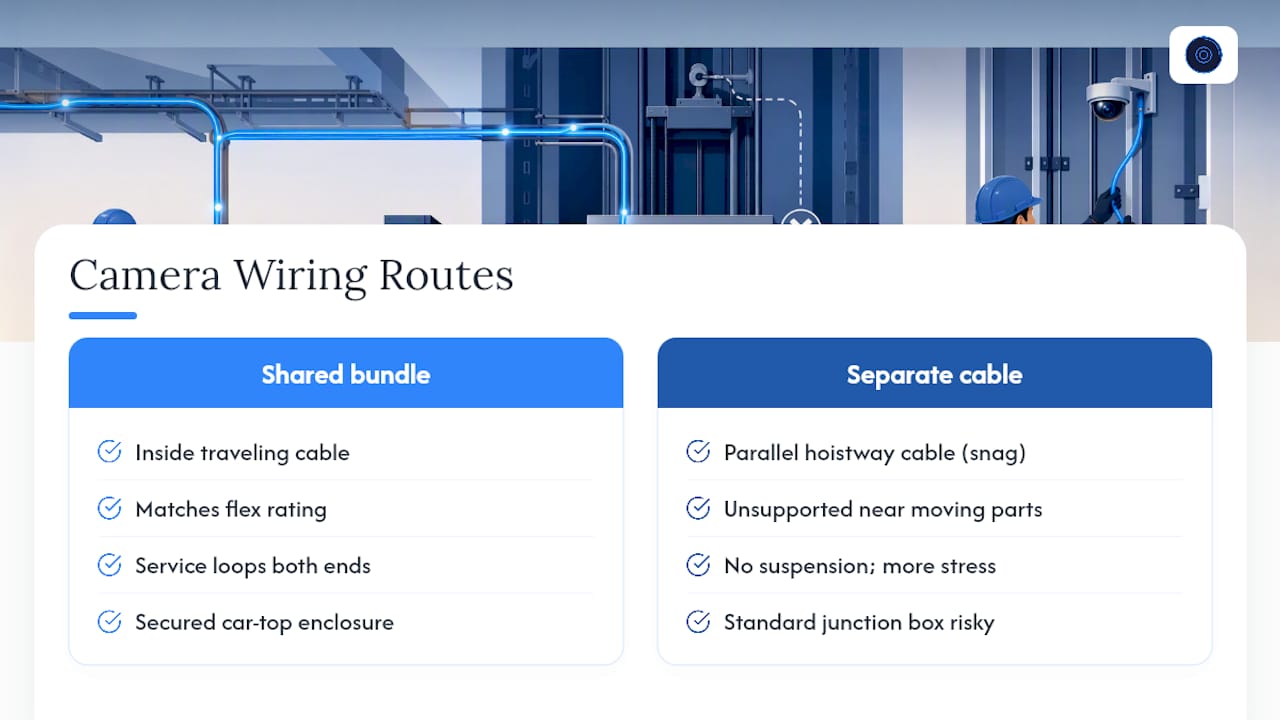
Cable routing inside a hoistway has to survive thousands of flex cycles a year, which rules out any wiring practice borrowed from a static building install. Traveling cable itself is designed with a suspended loop that flexes as the car moves, and any new conductor or fiber added to that loop must match the flex rating of the existing cable rather than being taped or zip-tied to the outside of it.
Route camera conductors through the same traveling cable bundle whenever possible rather than running a separate parallel cable in the hoistway, since a second unsupported cable becomes a snag hazard against guide rails, counterweights, and other moving hardware. Where a media converter sits at the car top, mount it inside a secured, vibration-rated enclosure rather than a standard junction box, and leave enough service loop at both ends to allow future termination work without disturbing the traveling cable’s suspension point.
Bonding and grounding deserve particular attention in a metal hoistway environment. Shielded conductors need their shield terminated at one end only to avoid ground loops that introduce video noise, and any fiber run should include a slack loop at both the car-top and machine-room ends to absorb cable movement without stressing the connector. Label every conductor at both ends during installation, since a mislabeled pair found during a later service call in a dark hoistway costs far more time than the five minutes labeling takes upfront.
How Cab Lighting Affects Elevator Surveillance Camera Selection
Elevator cab lighting is rarely designed with a camera in mind, and that mismatch causes more image quality complaints than any hardware defect. Most cabs run overhead fluorescent or LED panels that create strong top-down light and correspondingly deep shadows on a passenger’s face when a camera is also mounted near the ceiling, which is exactly the geometry that produces the washed-out, shadow-heavy footage building managers often complain about.
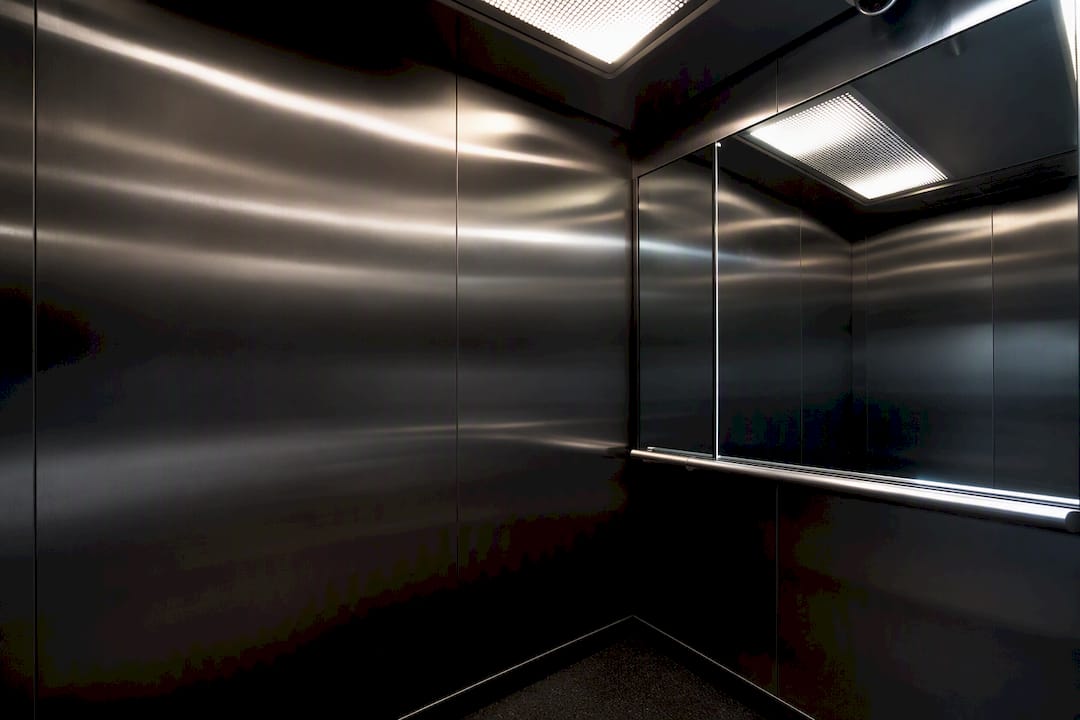
Wide dynamic range, commonly abbreviated WDR, matters more in an elevator cab than in almost any other indoor camera application because the fixture is close, bright, and directly in the camera’s field of view. A camera without adequate WDR will either blow out the ceiling light to pure white or crush the passenger’s face into shadow, and there’s no lens or mounting-angle fix for a sensor that can’t handle the contrast.
Cab finishes compound the problem. Stainless steel walls and mirrors reflect the ceiling fixture back into the frame, creating hot spots that confuse basic auto-exposure algorithms. A camera with true WDR, not just digital contrast enhancement, handles these reflective surfaces far better. For freight elevators with dimmer or inconsistent lighting, infrared-capable cameras with automatic day and night switching maintain usable footage even when the cab lighting is marginal, which matters most during off-hours when incidents are statistically more likely to occur.
Integrating Elevator Cameras With Control and Alarm Systems
An elevator camera that only records to a local drive misses most of its value. Integration with the building’s broader access control and alarm system turns a passive recording device into an active part of the security stack, letting an incident on video trigger a real response instead of sitting unwatched until someone requests footage after the fact.
The most useful integration point is tying the camera feed to an alarm event, such as an emergency stop, a door-open sensor that stays active too long, or a call-button alert from the car’s emergency communication system. When any of those triggers fires, the monitoring station can pull up the live elevator feed alongside the alarm, rather than a guard scrolling through camera tiles trying to find the right car. This kind of event-linked viewing is standard practice in broader CCTV integration and monitoring setups and applies just as directly to elevator cabs as it does to lobbies and stairwells.
Access control integration adds another layer for buildings that require a key fob or code to select certain floors. Logging which credential requested which floor alongside the camera timestamp gives building management a complete record without needing to cross-reference two separate systems by hand. Our checklist of security camera features for property managers covers the integration specs worth confirming before signing off on any camera purchase.
Network Security for Elevator Camera Systems
An elevator camera sitting on the building’s main network is a soft target if it isn’t isolated properly, since the traveling cable path that makes installation convenient also gives an attacker a physical entry point that’s harder to monitor than a rack-mounted server. Segmenting camera traffic onto its own VLAN, separate from tenant Wi-Fi and general building IT, keeps a compromised camera from becoming a stepping stone into more sensitive systems.
Every camera and media converter should ship with default credentials changed before commissioning, not left for a future maintenance visit. Firmware updates matter more for elevator cameras than for most other installs because the devices are physically harder to reach, which means a vulnerability left unpatched tends to stay unpatched far longer than on an easily accessible lobby camera. Encrypting the video stream between the car-top camera and the monitoring station protects against interception on the traveler cable run, particularly important given that the cable itself is shared infrastructure running past machine room equipment that other contractors may access.
Cellular or cloud-connected backup links, when used for redundancy on high-rise installs, need the same encryption and credential discipline as the primary wired path. A backup connection that skips these basics defeats the purpose of building redundancy in the first place.
Get an Elevator Camera Installation Site Survey
YDA Security Systems NYC handles elevator camera installation and full-building security camera projects across Manhattan, Brooklyn, Queens, Staten Island, and the wider NYC market, with licensed and insured technicians who coordinate directly with your elevator maintenance contractor so there’s no scheduling guesswork on your end. Where a typical camera vendor leaves the traveler cable coordination and ASME compliance questions to you, we handle the site survey, the vendor scheduling, and the documentation as part of the same engagement.
A site survey covers the traveling cable conductors available, car-top power access, and whether your building falls under the ASME A17.1-2019 video mandate, followed by a written scope and timeline before any hoistway work begins. Every installation carries a one-year warranty. If you’re planning an elevator camera installation or need a broader security camera installation project scoped for your property, request a quote and we’ll schedule a survey around your elevator contractor’s availability.
Sources
Elevator camera installation decisions carry real code and liability weight, so verify claims against primary sources before committing to a design. The ASME 2019 video communication mandate breakdown explains the rise threshold and retrofit cost range in detail. IPVM’s elevator surveillance guide remains the most thorough technical reference on transmission methods and camera placement written for security integrators specifically. For the legal boundaries around video and audio capture, Catalyst Legal’s overview of elevator surveillance laws lays out the wiretapping distinction clearly. Always confirm your state and local AHJ’s specific adoption of ASME A17.1-2019, since adoption timing varies by jurisdiction and determines whether the video mandate applies to your building today.
- ASME 2019 Video Mandate: $8K Per Elevator – Elevator Blueprint
- Elevator surveillance laws: understanding cameras in elevators – Catalyst Legal
- Elevator Surveillance Guide (Public Report) – IPVM
FAQ
Is It Legal to Have a Camera in an Elevator?
Yes. Video surveillance in elevator cabs is generally legal in the United States because passengers have no reasonable expectation of privacy in that shared space, though audio recording faces much stricter wiretapping restrictions and is typically disabled.
What Is an Elevator Cam?
An elevator cam is a security camera, usually a mini-dome or corner-mount unit, installed inside an elevator cab and connected through the traveling cable to a building’s monitoring or recording system.
Is There a Camera in Every Elevator?
No. Camera installation isn’t universally required, though buildings with elevators rising roughly 60 feet or more may need two-way video communication under ASME A17.1-2019 where that provision has been adopted locally.
What’s the Best Camera Setup for an Elevator?
A ceiling-mounted mini-dome with a 2.8mm wide-angle lens, wide dynamic range for handling cab lighting, and 1080p resolution covers most passenger elevator surveillance camera needs; freight cars may need a tighter lens or infrared capability for dimmer conditions.
How Much Does Elevator Camera Installation Cost?
Retrofits tied to ASME A17.1-2019 compliance typically run $5,000 to $10,000 per elevator car, with the higher end driven by new traveling cable, monitoring integration, or cellular backhaul requirements.