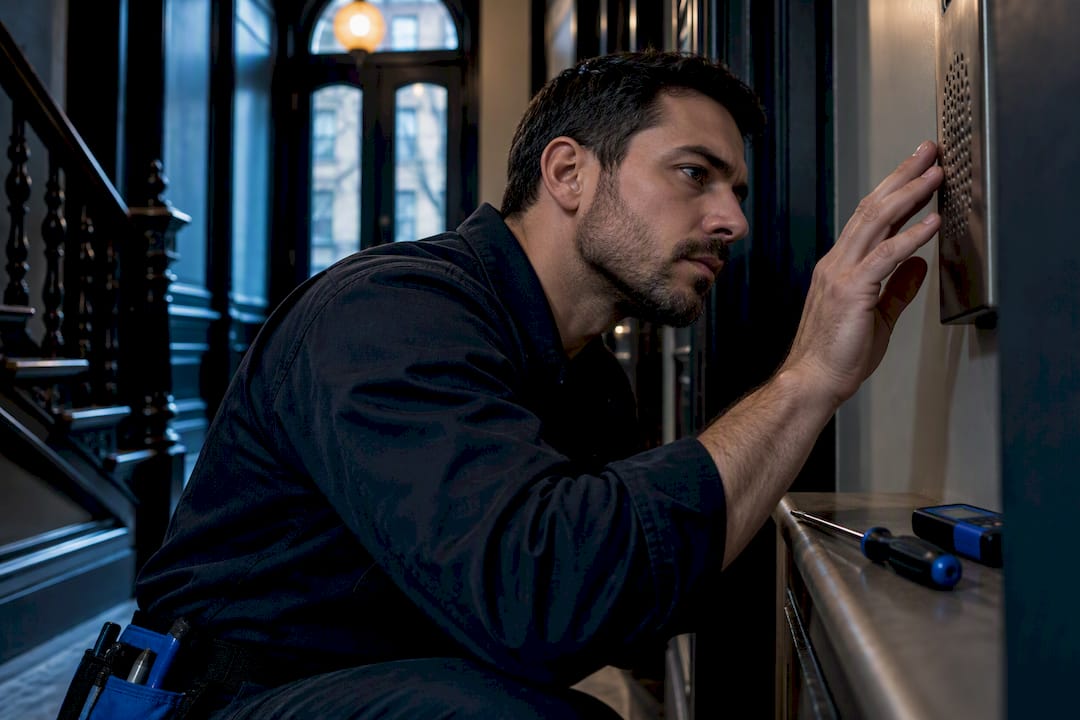
A prevention-first anti theft camera system, one built with planned coverage, tamper-resistant mounts, AI-based detection, and monitored response, stops most opportunistic theft before it happens and produces usable evidence when it doesn’t. Raw resolution matters far less than detection speed and hardware that can’t be knocked out in ten seconds. YDA Security Systems NYC designs and installs these systems for property owners across Manhattan, Brooklyn, Queens, and Staten Island, and the outcome is consistent: faster deterrence, quicker incident resolution, and footage that holds up with police and insurers.
TL;DR:
- Most thefts can be prevented with a layered system that combines tamper-resistant hardware, concealment, and AI detection, rather than relying on megapixel count.
- Using a hybrid architecture that maintains local PoE/NVR recording, overlays AI detection, and employs remote monitoring targets the highest-risk points for faster response.
- Proper site survey and coverage planning using DORI standards ensure cameras are positioned to identify and recognize suspects effectively, minimizing blind spots.
- Regular maintenance, firmware updates, and tamper alarms are critical to prevent quiet failures that could be exploited during theft attempts.
- A comprehensive plan includes 30 to 90 days of footage retention, with real-time incident alerts and strict export protocols to improve theft case resolution.
Table of Contents
- Anti Theft Camera System Architectures and When to Use Each
- Anti Theft Features to Prioritize (Hardware and Software)
- How Should You Plan Camera Coverage to Stop Theft?
- Installation and Hardware Practices That Prevent Failures
- Storage, Retention, and Monitoring Workflows That Make Footage Useful
- Maintenance, Health Checks, and Common Failure Modes
- How to Choose a Professional Anti Theft Camera Installer
- Why Property Owners Trust YDA Security Systems NYC
- Contact YDA for a Free Site Survey and Tailored Anti Theft Solution
- Sources
- FAQ
Anti Theft Camera System Architectures and When to Use Each
Not every property needs the same backbone. Choosing the wrong architecture is the single most common reason a camera investment underperforms once real theft attempts to happen.
PoE/NVR systems run power and data over one Ethernet cable to a local network video recorder. This is the standard for most commercial and residential retrofits in NYC because it keeps footage on-site, avoids ongoing bandwidth costs, and survives an internet outage. The tradeoff is that someone has to actively review or configure alerts on that footage, or it just sits there until you go looking for it after a loss.
Cloud VMS (video management systems) push footage to remote servers, giving owners with multiple locations, say a retail chain with stores in three boroughs, a single dashboard to check every site from one phone. Latency and monthly subscription costs are the tradeoff, along with a dependency on upload bandwidth that older buildings sometimes can’t support.
Camera-bound analytics run detection logic (person, vehicle, loitering) directly inside the camera itself, as explained by AI security cameras: choose the right smart camera. This cuts server load and works even if the network briefly drops, but the analytics quality is locked to whatever chipset the manufacturer shipped, and upgrading intelligence usually means replacing the camera.
Camera-agnostic AI overlays sit on top of an existing camera estate, wired or wireless, and add smarter detection without ripping out hardware that still works. Modern Video AI Agents can package searchable, timestamped incident clips and trigger real-time deterrence, which matters given that shoplifting and theft incidents rose 93% between 2019 and 2023. Detection speed, not megapixel count, is what actually moves that number for a given property.
Remote guard monitoring adds a live human (or a monitoring center) watching feeds in real time, with the ability to trigger talk-down warnings or dispatch. This is the highest-cost tier but the fastest response.
For most existing NYC properties, a hybrid approach wins:
- Keep the current PoE/NVR backbone for local recording and chain-of-custody
- Layer a camera-agnostic AI overlay on top for detection and alerting
- Add remote guard monitoring only at the highest-risk points (loading docks, cash offices, main entries)
- Reserve a full camera swap for zones where existing hardware genuinely can’t meet DORI pixel-density targets
This sequencing protects the capital already sunk into a system while closing the actual gap, which is almost always detection speed rather than image quality.
Anti Theft Features to Prioritize (Hardware and Software)
A camera that gets ripped off the wall in under a minute isn’t a deterrent, it’s a liability with a warranty claim attached. The features below separate a system that survives contact with a determined thief from one that doesn’t.
- Tamper detection and alerts. The camera or NVR fires an alert the instant a lens is covered, redirected, or the housing is opened, giving staff or a monitoring center a chance to react before the feed goes dark.
- Tamper-resistant housings with locking screws and cages. Vandal-rated (IK-rated) domes and steel cages around exposed cameras add real friction against anyone trying to disable the unit with a tool in ten seconds flat.
- Concealed wiring and conduit. Running cable inside conduit or through walls instead of along an exposed surface removes the easiest attack: cut the cable, kill the camera.
- Lockable junction boxes and secured PoE switch placement. The switch feeding a dozen cameras should never sit in an unlocked closet a tenant or delivery driver can access.
- AI person and vehicle detection. Rule-based motion alerts flood inboxes with false positives from cats and shadows; AI classification cuts that noise and surfaces the events that matter.
- Talk-down speakers and triggered lighting. A camera that can say “you are being recorded, leave the property” or flip on a floodlight the instant it detects a person after hours does active deterrence, not just passive recording.
- Visible units paired with strategically placed covert units. Visible cameras and clear signage deter the opportunistic thief; a covert unit at the same choke point catches the person who cases the visible camera first and tries to work around it.
Concealed wiring, tamper alarms, and secure mounting consistently rank as the cheapest, highest-return anti-theft upgrades available, well ahead of jumping from a 4MP to an 8MP sensor.
Pro Tip: If a camera is mounted anywhere within reach of a ladder, step stool, or dumpster, budget for a locking cage from day one. Retrofitting one after the first theft attempt always costs more than installing it up front.
Signage deserves its own mention. A visible “24 Hour Video Surveillance” placard at every entrance is not decoration. It’s a documented part of the deterrence layer, and in several jurisdictions it also factors into what a property owner must disclose about recording on the premises.
How Should You Plan Camera Coverage to Stop Theft?
A camera pointed at the wrong angle is worse than no camera at all, because it creates a false sense of coverage. Coverage planning starts with a site survey, not a shopping list of hardware.
Walk the property and map every point where theft actually happens, not every wall that has a convenient mounting spot. Coverage planning should prioritize entry and exit sequences, cash and asset points, loading docks, elevators, stairwell doors, and parking circulation, because those are the choke points where a thief has to physically pass through, giving overlapping fields of view a real chance to capture a usable face or plate.
A practical site-survey checklist looks like this:
- Trace the exact path someone takes from the street to the target asset, and back out
- Identify every door, gate, or turnstile along that path
- Note existing lighting conditions at each point, including how they change after dark
- Flag blind spots created by pillars, signage, parked vehicles, or landscaping
- Confirm where power and network drops already exist versus where new runs are needed
Once the choke points are mapped, apply DORI, the standard framework for matching camera specification to purpose. DORI stands for Detect, Observe, Recognize, and Identify, and each tier corresponds to a minimum pixel density on target:
| DORI level | What it achieves | Typical use |
|---|---|---|
| Detect | Confirms a person or object is present in frame | Perimeter, parking lot edges |
| Observe | Shows general activity and movement patterns | Parking circulation, common areas |
| Recognize | Determines whether a person is known or a stranger | Entry doors, hallways |
| Identify | Captures enough detail for positive identification | Cash points, main entrance, loading dock |
The mistake most property owners make is buying a camera rated for “detect” and expecting “identify” results at the front door. A wide-angle lens covering a whole parking lot is great for spotting a group approaching, but it will never resolve a face clearly enough to hand to police. Reserve narrower lenses and closer mounting distances for identify-tier zones, and let the wider units handle general area awareness.
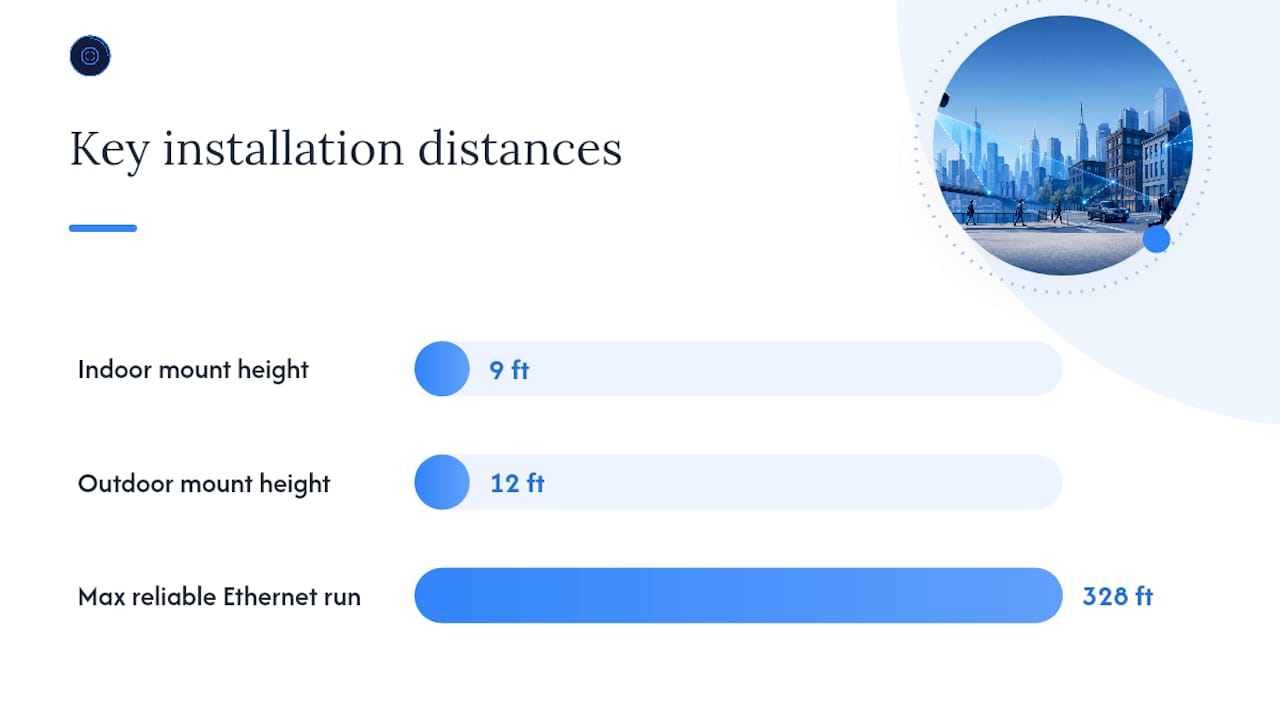
Mounting height follows the same logic. Cameras aimed at faces at an entry point work best between 8 and 9 feet, angled slightly downward, high enough to be out of easy reach but low enough to avoid a steep angle that distorts facial features. Overlapping fields of view at every choke point means one obstructed or vandalized camera doesn’t create a total blind spot, which is exactly the kind of redundancy a real-world commercial surveillance layout is built around.
Installation and Hardware Practices That Prevent Failures
The gap between a system that works for five years and one that fails within eighteen months almost always comes down to what’s inside the walls, not what’s on them.
- Specify pure-copper Cat6, never Copper Clad Aluminum (CCA). CCA is a documented, leading cause of PoE failures on longer cable runs, because the thinner copper layer can’t reliably deliver power over distance. It costs less per foot up front and costs far more in truck rolls later.
- Size the PoE standard to the camera load. 802.3af handles basic fixed cameras, 802.3at covers PTZ units and heaters, and 802.3bt is often required for multi-sensor or panoramic cameras drawing higher wattage. Undersizing the switch budget is a common reason cameras randomly reboot in cold weather.
- Follow cable-distance rules. Standard Ethernet runs reliably up to 328 feet; beyond that, a mid-span switch or a fiber uplink is the correct fix, not a longer copper run that will drop packets intermittently.
- Mount at code-appropriate, tamper-resistant heights. Roughly 8 to 10 feet indoors and 10 to 14 feet outdoors keeps units above casual reach while staying within DORI-appropriate angles, paired with anti-tamper brackets on any unit near a fire escape, dumpster, or accessible roofline.
- Add surge protection and a UPS for the NVR and PoE switch. A single power spike during a Con Edison brownout can take down an entire camera estate at once; battery backup keeps recording through short outages, which is exactly when opportunistic theft tends to happen.
- Route mains power work through a licensed electrician. Low-voltage camera wiring and mains electrical work are different trades and different code requirements; a reputable installer scopes them separately rather than having one crew touch both.
Commissioning is where installs are won or lost. Standard commissioning steps include manual focus using a focus chart set at the actual DORI distance, verifying the IR mode holds focus after dark, locking the focus ring so vibration doesn’t drift it, configuring a single NTP time source across every device, and running a live motion test to confirm alerts and clip capture actually fire.
Pro Tip: Test every camera’s infrared performance at night before calling the job finished. A camera that looks sharp at noon can wash out into a white blur after dark if the IR array wasn’t focus-checked in low light, and that’s the exact window most theft happens in.
Property owners in older buildings should also confirm firmware is current on every device before handover. Default firmware on out-of-box cameras and NVRs is a known soft spot, and proper installation guidance treats a firmware update as a mandatory commissioning step, not an optional one.
Storage, Retention, and Monitoring Workflows That Make Footage Useful
Footage that nobody can find fast enough is functionally the same as no footage. Retention and monitoring design determines whether a theft claim gets resolved in a day or gets written off entirely.
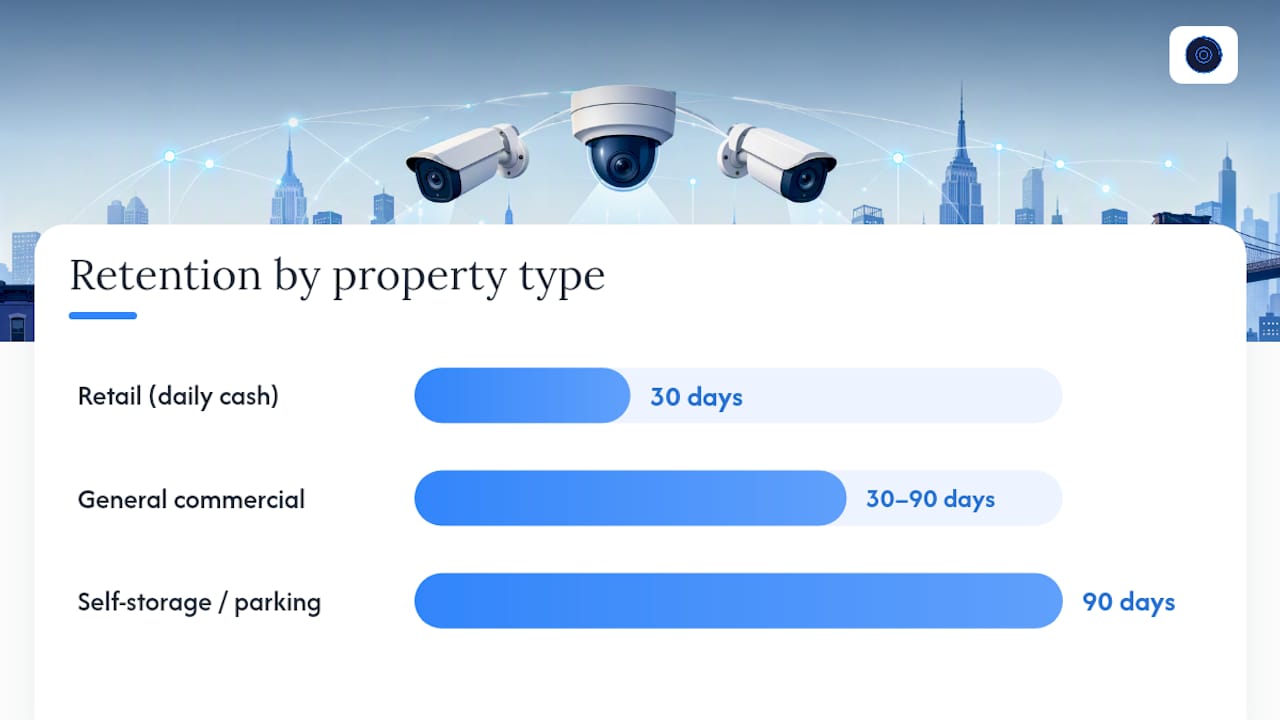
Commercial retention commonly runs 30 to 90 days, and the right number for a given property depends on how quickly incidents get reported. Retail with daily cash handling can often run toward the shorter end since discrepancies surface fast; a self-storage facility or parking structure, where a tenant might not notice a theft for weeks, needs to sit closer to 90 days. Sizing the NVR’s drive array, or the cloud storage tier, to that retention window up front avoids the painful discovery that footage from three weeks ago already overwrote itself.
- On-prem NVR storage keeps a clean chain of custody, since footage never leaves the building until it’s deliberately exported, which insurers and police departments generally prefer.
- Cloud VMS storage earns its cost for multi-site owners who need to pull footage from a Brooklyn location and a Queens location without driving to either one.
- A hybrid setup, local NVR for primary retention with cloud backup for critical cameras, covers both bases without doubling the budget.
- UPS backup on the NVR and switch stack keeps recording alive through brief outages instead of leaving a gap exactly when someone might exploit a dark building.
Shoplifting incidents climbed 93% between 2019 and 2023, and that trajectory is a large part of why detection speed now matters more than storage duration alone. A system that flags an incident in real time and hands staff a timestamped clip within seconds resolves far more cases than one where someone has to scrub through 60 hours of footage after the fact.
Automated incident creation, Video AI Agents that watch continuously and package a searchable clip the moment something matches a defined rule, turns that scrub-through process into a five-minute lookup. Pair that with remote guard monitoring on the highest-risk cameras and response time drops from “whenever someone checks” to “within the minute.”
Export and chain-of-custody discipline matters just as much as the footage itself. Export clips in their native format, log who pulled them and when, and avoid re-encoding footage before handing it to police or an insurer, since re-encoding can raise authenticity questions later. A documented retention and export process for small business footage is the difference between a claim that gets paid and one that gets disputed on a technicality.
Maintenance, Health Checks, and Common Failure Modes
Cameras don’t fail dramatically. They fail quietly, usually months before anyone notices, and the theft that exploits that blind spot is rarely the first attempt.
A working quarterly maintenance schedule covers lens cleaning, focus verification, firmware updates, and a check of storage drive health on the NVR. Daily or weekly automated health alerts, flagging an offline camera or a full storage drive, catch the problems that would otherwise sit unnoticed until someone goes looking for footage that isn’t there.
- Test UPS battery health on a set interval and replace on manufacturer schedule, not “when it stops working”
- Verify RAID array status on the NVR monthly if drives are configured for redundancy
- Re-check camera angles seasonally, since foliage that was trimmed back in spring can fully obscure a lens by August
- Rotate and confirm all default passwords were changed at commissioning, and again after any firmware reset
- Audit alert logs weekly to confirm someone is actually acting on tamper and motion alerts, not just receiving them
The most common failure modes share a pattern: a default password left unchanged that lets an intruder disable the feed remotely, a CCA cable run that starts dropping frames intermittently until it fails outright, seasonal foliage growth that nobody re-checked, and alerts that get muted after one too many false positives from a delivery truck. Each one is preventable with a maintenance schedule; none of them announce themselves until the footage is needed and isn’t there.
How to Choose a Professional Anti Theft Camera Installer
The bid that looks cheapest on paper is often the one cutting corners a property owner won’t discover until the first real theft attempt. A short interview before signing a contract catches most of that risk.
- Ask for a sample site plan showing camera placement and fields of view, not just a line-item equipment list. A contractor who can’t produce this hasn’t actually surveyed the property.
- Ask how they calculated DORI targets for each zone. If the answer is vague, the coverage plan was likely guessed rather than engineered.
- Ask for the PoE budget calculation and cable specification. A written answer confirming pure-copper Cat6 and a switch sized to the actual camera load is the correct one; hesitation here is a warning sign.
- Ask about warranty terms and what’s covered. A contractor confident in their work will put it in writing.
- Ask for proof of insurance and licensed-electrician sign-off on any mains-power work involved in the install.
- Ask for reference projects of similar scope, ideally ones that can be verified.
Several red flags should end a bid on the spot: a contractor who quotes Copper Clad Aluminum cable without disclosing it, one who can’t produce proof of insurance or licensing, one who refuses to document the retention schedule or signage plan in writing, and one with no verifiable past projects at all.
The right procurement process runs through staged commissioning (survey, install, calibration, acceptance test) rather than a single “flip the switch and leave” visit. An acceptance test should include a live walk-through where the property owner watches motion alerts fire and confirms footage quality at each DORI-critical zone, followed by hands-on training and a written handover pack covering login credentials, retention settings, and a maintenance contact. Integrating cameras with existing alarms and access control at this stage, rather than as an afterthought, is what turns a camera system into an actual security system.
Why Property Owners Trust YDA Security Systems NYC
YDA Security Systems NYC has installed anti-theft camera systems for more than 5,000 satisfied clients across Manhattan, Brooklyn, Queens, and Staten Island, and every job carries a 1-year installation warranty backed by licensed and insured technicians. That track record spans retail stores, restaurants, gyms, hotels, schools, and residential buildings, each with a different theft profile and coverage plan.
Every install draws on the same standards covered above: DORI-based coverage planning, pure-copper Cat6 wiring, properly sized PoE, and AI-enabled detection layered onto CCTV, access control, motion sensors, and integrated door hardware. YDA works with established hardware lines including Hikvision, Uniview, ButterflyMX, and 2N, and pairs camera installation with commercial and residential locksmith services so the physical door and the camera watching it get treated as one system, not two separate vendors.
The installation process itself follows the staged approach outlined earlier: a site survey to map choke points and asset locations, a coverage plan built around DORI targets, professional commissioning with focus and IR checks, and a documented handover with training on retention and alert management. Response times run fast because the crews doing the survey are the same ones doing the install, not a subcontracted install and a separate design team working from someone else’s notes.
Contact YDA for a Free Site Survey and Tailored Anti Theft Solution
Most theft prevention plans fail for the same reason: a homeowner or property manager tries to solve coverage gaps, tamper risk, and evidence retention with hardware bought off a shelf, with no site survey behind it. YDA Security Systems NYC starts every anti theft camera system with an on-site walk-through instead, mapping choke points, verifying DORI targets, and specifying tamper-resistant hardware before a single camera goes on the wall.
That process is available across all NYC boroughs served, Manhattan, Brooklyn, Queens, and Staten Island, whether the property is a single retail storefront or a multi-building residential portfolio. If door hardware and access control need attention alongside the camera plan, YDA’s technicians handle both in the same visit rather than sending separate crews weeks apart.
Property owners ready to close the gaps a DIY setup leaves behind can schedule a residential and commercial security camera installation survey directly, and get a coverage plan built around the actual theft risks the property faces, not a generic equipment list.
Sources
- NRF: Shoplifting incidents jump 93% since pre-COVID
- CCTV installation best practices: Office, warehouse & plant
- How to Safeguard Your Outdoor Cameras from Thieves — Reconeyez
- Commercial security camera system buyer’s guide — Spot AI
FAQ
Do Security Cameras Actually Deter Thieves?
Visible cameras paired with signage reduce opportunistic theft attempts, and pairing surveillance with monitored alerts and access control materially cuts property crime beyond what cameras alone accomplish. A camera that’s clearly monitored and hard to disable stops far more attempts than one that just records passively.
What Is the Most Secure Anti Theft Camera System?
The most secure setup combines a PoE/NVR backbone for reliable local recording, tamper-resistant hardware and concealed wiring so the camera can’t be disabled in seconds, and an AI overlay or monitored response layer for real-time detection. No single camera model provides this; it comes from how the whole system is designed and installed.
How Do I Keep My Security Camera From Being Stolen?
Mount cameras out of easy reach (8 to 10 feet indoors, 10 to 14 feet outdoors), add locking screws or a vandal-rated cage on exposed units, and run wiring through conduit so it can’t be cut from outside. Tamper alarms that trigger the instant a housing is opened add another layer that a simple locked bracket doesn’t.
What Is the Best Anti Theft Security System for a Home or Business?
The best setup for most properties is a hybrid: an existing or new PoE/NVR system for local recording, layered with AI-based detection for real-time alerts, and covering every choke point identified in a proper site survey. YDA Security Systems NYC builds exactly this kind of layered system for residential and commercial properties across NYC.
How Long Should Security Camera Footage Be Retained?
Most commercial properties retain footage for 30 to 90 days, with the shorter end fitting operations that reconcile daily (like retail cash handling) and the longer end fitting properties where a loss might not be noticed for weeks, such as storage facilities or parking structures.