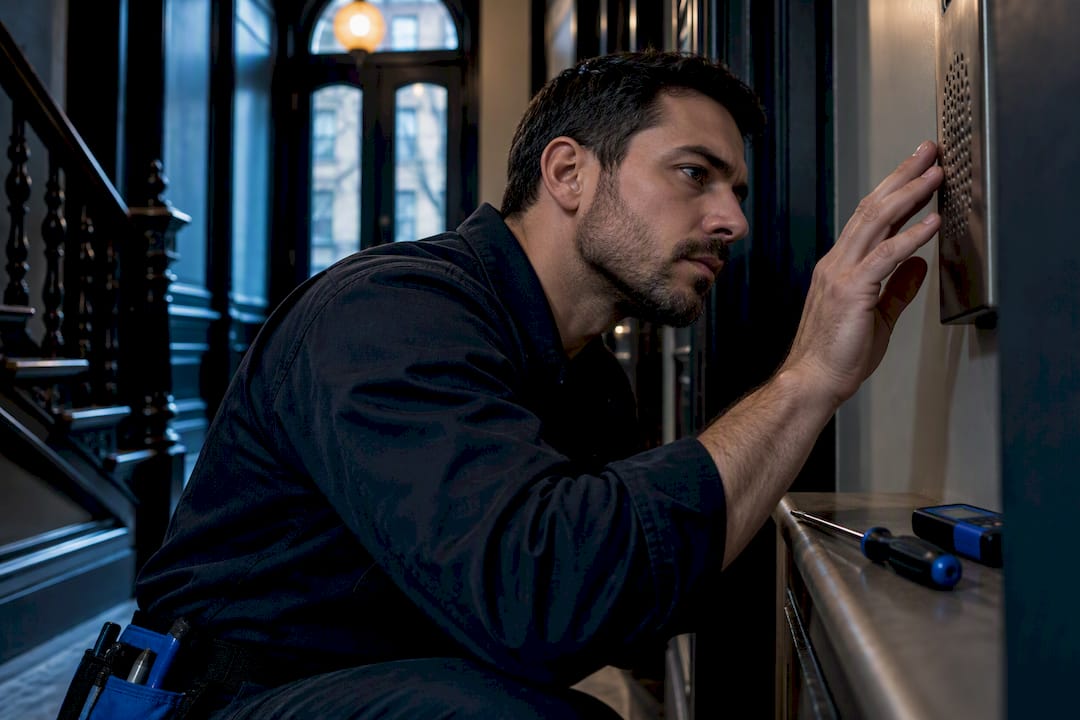
When a camera stops recording or a keypad goes dead, the manufacturer’s warranty typically covers the equipment defect while the installer’s workmanship warranty covers mistakes made during setup, wiring, or mounting. A service contract is neither of these; it pays for ongoing maintenance, not defects. The moment your system goes live, record every serial number, register the equipment with the manufacturer, and file away your installer’s final sign-off paperwork.
TL;DR:
- Warranties are layered, with manufacturer coverage for equipment defects and installer guarantees for installation errors; understanding these layers helps direct claims correctly.
- Manufacturer warranties typically last one to ten years and cover parts and manufacturing faults, while workmanship warranties often last about one year and cover installation errors.
- Proper documentation of serial numbers, installation photos, and signed completion certificates at handover speeds up claims and reduces disputes.
- Warranties can be voided by environmental damage, unauthorized modifications, missed firmware updates, or unapproved parts, making careful adherence to terms essential.
- Contractors should provide explicit, written warranty terms, including labor coverage and response times, before signing agreements to prevent coverage gaps.
Table of Contents
- What Does a Security System Installation Warranty Actually Cover?
- How Long Do Manufacturer and Installer Warranties Typically Last?
- What Voids a Security System Warranty?
- How Do You File a Security System Warranty Claim?
- Extended Warranties vs. Service Contracts: Which Do You Need?
- Do Codes and Federal Law Affect Your Warranty Rights?
- What Red Flags Should You Watch for in Warranty Contracts?
- How YDA Security Systems NYC Builds Warranty Protection Into Every Installation
- How to Choose an Installer With Strong Warranty Practices
- Get a Warranty-Backed Security Installation in NYC
- Sources
- FAQ
What Does a Security System Installation Warranty Actually Cover?
A security system installation warranty rarely means one single guarantee. It usually stacks three separate layers of protection, and knowing which layer applies to a given failure determines who you call first.
The manufacturer warranty covers the equipment itself: the camera housing, the control panel board, the door strike motor. If a component fails because of a manufacturing defect, in most cases you contact the manufacturer or its authorized service center directly, not the company that mounted the hardware on your wall. These warranties typically cover parts and sometimes limited labor, though many exclude labor entirely unless the contract states otherwise.
The installer workmanship warranty covers something different: the quality of the work performed. If a camera falls off a wall because it was mounted into drywall without proper anchors, or if a keypad malfunctions because of a wiring short introduced during installation, that failure belongs to the installer, not the equipment maker. A reputable contractor should respond within a defined window, dispatch a technician, and correct the error at no charge to you.
Beyond these two express warranties sit implied protections. Federal consumer law generally holds that goods must work as reasonably expected for a reasonable period, even without a written promise. These implied protections rarely override an express warranty’s specific terms, but they matter when a contract is silent or ambiguous, and they interact directly with the Magnuson-Moss Warranty Act, which we cover in more detail later.
Here is how the layers typically break down in practice:
- Manufacturer warranty: covers parts and manufacturing defects; contact the manufacturer or authorized dealer directly.
- Installer workmanship warranty: covers mounting, wiring, and labor errors; contact the installing contractor.
- Implied protections: back up both layers when contract language is unclear or absent.
- Service contract: covers ongoing maintenance and support, separate from any warranty entirely.
Take a common example: a security camera goes dark six months after installation. If the sensor itself failed internally, that is a manufacturer claim. If the camera failed because a low voltage wire was pinched during installation and shorted the board, that is a workmanship issue, and the installer should bear the repair cost. Tracing the actual cause, not just the symptom, is the first job in any dispute.
How Long Do Manufacturer and Installer Warranties Typically Last?
Manufacturer coverage on security equipment generally lasts for a range of years depending on the component, with some parts carrying longer terms than others. Installer workmanship warranties run shorter. Small contractors commonly offer one year, while larger, established firms may extend workmanship coverage across multiple years.
Registration deadlines matter more than most homeowners realize. Many manufacturers require product registration within 30 to 60 days of installation to activate full warranty benefits, and missing that window can leave you with reduced coverage even though the equipment is otherwise still under its stated term.
A few practical steps protect you regardless of how long any single warranty runs:
- Register every device immediately. Do this within days of installation, not months later when the paperwork gets buried.
- Confirm transferability before you sell. Some manufacturer and installer warranties transfer to a new property owner; others void automatically at the sale, so read the relocation clause before listing your home.
- Log installation and activation dates in a single document, alongside every serial number for cameras, panels, and locks.
- Photograph the finished installation the day it is completed, including wiring runs and mounting points.
- Keep the contractor’s signed completion certificate. This single document often decides whether a workmanship claim gets approved without argument.
A layered approach to manufacturer, installer, and third-party coverage is the standard model across the security industry, and homeowners who track registration dates alongside serial numbers consistently have faster, cleaner claims experiences than those who rely on memory.
What Voids a Security System Warranty?
Warranties get denied for reasons that are usually preventable, and knowing the common triggers ahead of time saves both money and frustration.
Standard exclusions across most security equipment warranties include environmental damage from flooding or lightning strikes, accidental damage from impact or misuse, normal wear on moving parts like door strikes, and battery degradation, which almost no manufacturer treats as a covered defect. Third-party devices not sold or approved by the original manufacturer, such as a generic keypad wired into a proprietary panel, typically fall outside coverage entirely.
Beyond passive exclusions, certain actions actively void coverage:
- Unauthorized modifications to wiring, panels, or mounting hardware after installation.
- Skipping required firmware updates that the manufacturer specifies as necessary for continued support.
- Allowing unlicensed technicians to service equipment originally installed under a licensed contractor’s warranty.
- Using replacement parts not approved by the original manufacturer.
Watch for specific contract language that signals weaker protection than it first appears. Phrases like “labor excluded” or “coverage at manufacturer’s discretion” mean the company retains broad latitude to deny claims that look, on the surface, like they should qualify. Consumer Reports has flagged this exact pattern in “lifetime” warranty marketing, noting that lifetime language frequently excludes the components most likely to fail, with real coverage terms buried in an equipment schedule appendix rather than the headline promise.
Pro Tip: Before signing anything, ask your installer to point to the exact clause that defines labor coverage. If they cannot show you the sentence, negotiate for it in writing before the job starts, not after something breaks.
How Do You File a Security System Warranty Claim?
A denied claim is often less about the failure itself and more about missing documentation. Building your file before you need it is the difference between a same-week repair and a monthslong dispute.
- Photograph the failed component immediately, including any visible damage, wiring, and its mounting location.
- Record the serial number from the unit itself, not just the box it came in, since installed units sometimes get swapped during setup.
- Pull your installation paperwork and proof of payment, both of which establish the installation date that starts your workmanship warranty clock.
- Contact the installer first if the failure looks workmanship related (loose mounting, wiring faults, configuration errors), and contact the manufacturer directly if the unit itself appears defective with no installation issue in sight. Starting with the wrong party wastes time, since installers usually cannot approve a manufacturer parts claim and manufacturers usually will not dispatch a technician for a labor issue.
- Gather maintenance logs and firmware update history if your system has any, since manufacturers increasingly ask for proof that required updates were applied before approving a defect claim.
A homeowner’s claim packet should include, at minimum: the serial number, installation date, a clear photo of the failure, your original invoice, and a short written description of when the problem started and what symptoms appeared. Detailed documentation at handover, including photos, serial numbers, installer signatures, and firmware versions, measurably shortens dispute cycles compared to claims filed with incomplete records. Our own step-by-step breakdown of the installation process shows exactly what a properly documented handover looks like from the technician’s side.
Extended Warranties vs. Service Contracts: Which Do You Need?
An extended warranty simply stretches the manufacturer’s original coverage window further into the future. A service contract is a completely different product: it pays for ongoing maintenance, inspections, and support regardless of whether anything is actually broken.
Extended coverage tends to make sense for expensive hardware with a short standard warranty, high-end camera systems or access control panels being common examples, and for any component whose replacement cost would sting if it failed just outside the standard term.
Service contracts typically bundle several ongoing services together:
- Scheduled dispatch for troubleshooting, usually within a defined response window.
- Routine inspections that catch wear before it becomes failure.
- Software and firmware updates applied on a regular schedule rather than left to the homeowner.
- Priority scheduling during high demand periods, such as after a storm knocks out multiple systems across a neighborhood.
Watch for a few red flags before enrolling in any third-party plan: vague language about what “covered service” actually includes, enrollment windows that expire shortly after installation with no grace period, and pricing that climbs sharply after an initial low introductory rate. Reviewing what a typical camera installation costs and what support comes bundled with it before you sign anything helps you compare the real value of an extended plan against simply paying for service calls as they come up.
Do Codes and Federal Law Affect Your Warranty Rights?
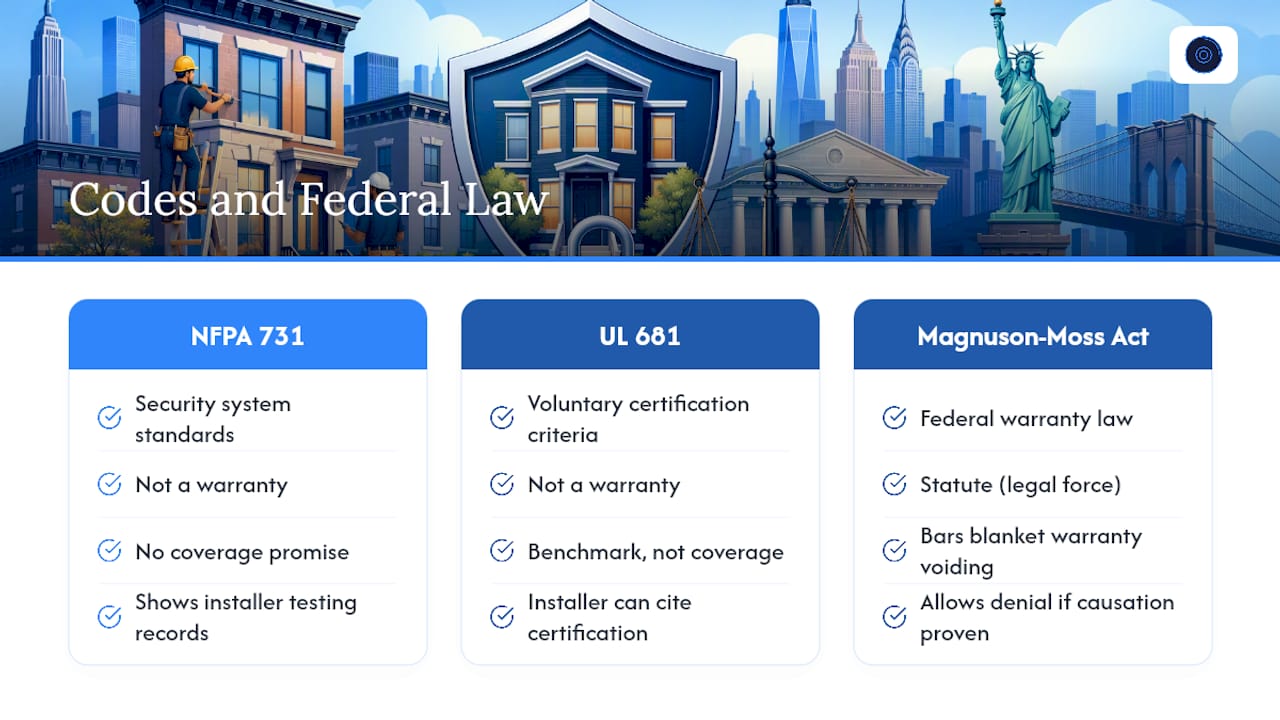
Two industry standards shape how installers document their work, and one federal law limits how aggressively a manufacturer can deny your claim.
NFPA 731 sets installation, testing, inspection, and maintenance requirements for premises security systems, covering everything from testing frequency to record-keeping for battery replacement schedules. UL 681 provides voluntary certification criteria that installers can reference as evidence their work meets recognized safety benchmarks. Neither standard functions as a warranty itself.
NFPA’s own standards documentation explicitly disclaims any warranty or guarantee tied to compliance statements, meaning the standard establishes a technical benchmark, not a legal promise of coverage.
That distinction matters when you’re evaluating a contractor: asking whether their installation follows NFPA 731 testing and maintenance provisions is a legitimate, useful question, but it is separate from asking what their workmanship warranty actually covers.
Federal law does more direct work for you. The Magnuson-Moss Warranty Act prevents a manufacturer from voiding your entire warranty simply because a third party touched the system. What it does allow is denial of a specific claim if that third-party work demonstrably caused the failure in question. That is a meaningfully narrower power than blanket voiding, and it is why documentation proving your installer’s work was done correctly protects you even against unrelated manufacturer pushback.
What Red Flags Should You Watch for in Warranty Contracts?
A handful of phrases and omissions consistently correlate with weaker real world coverage, even when the marketing language sounds generous.
- Any mention of “lifetime coverage” without a defined equipment schedule listing exactly which parts qualify.
- “Labor excluded” printed anywhere near the warranty summary, since labor is frequently the most expensive part of any repair.
- No stated response-time commitment for workmanship claims, leaving dispatch timing entirely at the contractor’s discretion.
- Registration or activation steps buried in fine print with no reminder from the installer at handover.
Ask your installer directly, during the estimate phase, for written confirmation of three things: explicit labor coverage terms, a stated response-time window for warranty repairs, and a documented claim procedure you can follow if something fails. A simple version of that negotiation script sounds like this: “Before we sign, can you put the labor coverage and response time in writing, along with how I file a claim if something goes wrong?” Most reputable contractors will not hesitate to answer.
Pro Tip: Ask for your final sign-off document and full serial number list at the moment of handover, not by email later. Contractors who provide this immediately, without prompting, are generally the ones who document their work carefully enough to back a warranty claim.
How YDA Security Systems NYC Builds Warranty Protection Into Every Installation
YDA Security Systems NYC installs intercom systems, security cameras, access control hardware, and locksmith solutions across NYC properties, with licensed and insured technicians handling every job. More than 5,000 clients have relied on our installations, and every job comes with a 1-year warranty covering the workmanship itself, separate from whatever manufacturer coverage applies to the equipment.
That distinction is exactly the one this guide has walked through: equipment defects go to the manufacturer, installation errors come back to us. We reduce friction on our end of that equation by documenting serial numbers, photographing finished work, and providing signed completion paperwork at handover, the same records this guide recommends you keep for any claim.
If you’re evaluating residential security camera installation or need access control installed with clear workmanship terms from day one, maintaining thorough documentation helps clients prove what was installed and when.
How to Choose an Installer With Strong Warranty Practices
Selecting an installer on price alone often costs more later, when a workmanship dispute drags on for weeks with no documentation to settle it. A short checklist during vendor selection prevents most of that pain.
- Ask for the workmanship warranty in writing before signing anything, including its exact duration and what labor it covers.
- Confirm the technicians are licensed and insured, and ask to see proof rather than taking a verbal assurance.
- Ask what documentation you receive at handover: serial numbers, photos, and a signed completion certificate should all be standard, not optional add-ons.
- Get an explicit response-time commitment for warranty repairs, ideally in business days rather than a vague “as soon as possible.”
- Compare installers on warranty breadth, not just length. A one-year warranty with full labor coverage and fast dispatch beats a three-year warranty riddled with exclusions.
Contractors who run structured quality practices, the kind small trade businesses build through operational coaching and process discipline, tend to produce the cleanest documentation trail. That trail is what separates a smooth warranty claim from a monthslong argument.
Get a Warranty-Backed Security Installation in NYC
Manufacturer warranties, workmanship guarantees, and service contracts each solve a different problem, and juggling all three on your own is where most homeowners lose time chasing the wrong department. YDA Security Systems NYC removes that guesswork by handling installation and workmanship coverage directly, with documentation collected at handover so a future claim never depends on your memory of what was installed.
We serve properties across Manhattan, Brooklyn, Queens, and Staten Island, installing intercom systems, CCTV, access control, door buzzers, and structured low-voltage wiring with licensed, insured technicians on every job. If your current door hardware needs replacing alongside a new camera system, our locksmith and door hardware installation service documents that work under the same 1-year workmanship warranty, so you are not tracking separate paperwork for separate contractors.
Ready to get a quote with clear warranty terms built in from the first estimate? Reach out to YDA Security Systems NYC to schedule a walkthrough and see exactly what documentation and coverage come with your installation.
Sources
FAQ
How long is a typical workmanship warranty?
Installer workmanship warranties commonly run one year for smaller contractors, with some larger firms extending coverage across multiple years. YDA Security Systems NYC provides a 1-year workmanship warranty on every installation.
What does a manufacturer equipment warranty typically cover?
Manufacturer warranties generally cover parts and manufacturing defects for a defined term, often ranging from one to ten years depending on the component, but frequently exclude labor unless the contract states otherwise.
How much does it cost to have a security system installed?
Installation costs vary widely based on the number of cameras, access points, and wiring complexity involved; a detailed cost breakdown for camera installation walks through the main pricing factors NYC property owners should expect.
Can a manufacturer void my entire warranty if someone else worked on the system?
No. The Magnuson-Moss Warranty Act prevents manufacturers from voiding an entire warranty over third-party work, though they can still deny a specific claim if that work demonstrably caused the failure.
What is the difference between a warranty and a service contract?
A warranty covers defects in equipment or workmanship for a defined period at no extra cost, while a service contract is a paid, ongoing arrangement covering maintenance, inspections, and support regardless of whether a defect exists.