
Access control system integration is defined as the process of unifying multiple security technologies, including credential readers, controllers, locks, cameras, and management software, into a single centralized platform that governs physical and digital access across an entire facility. This approach replaces siloed, disconnected systems with a coordinated architecture that delivers consistent identity verification, real-time monitoring, and enforceable security policies. For security professionals, facility managers, and operations decision-makers, understanding what is access control system integration means recognizing it as both a technical discipline and a strategic organizational investment. YDA Security Systems NYC designs and deploys these integrated platforms for commercial and residential properties across New York City.
What is access control system integration and how does it work?
Access control system integration connects hardware and software components into a unified security platform governed by centralized management software. The industry term for this discipline is integrated physical security, and it encompasses everything from credential issuance to real-time event logging and policy enforcement.
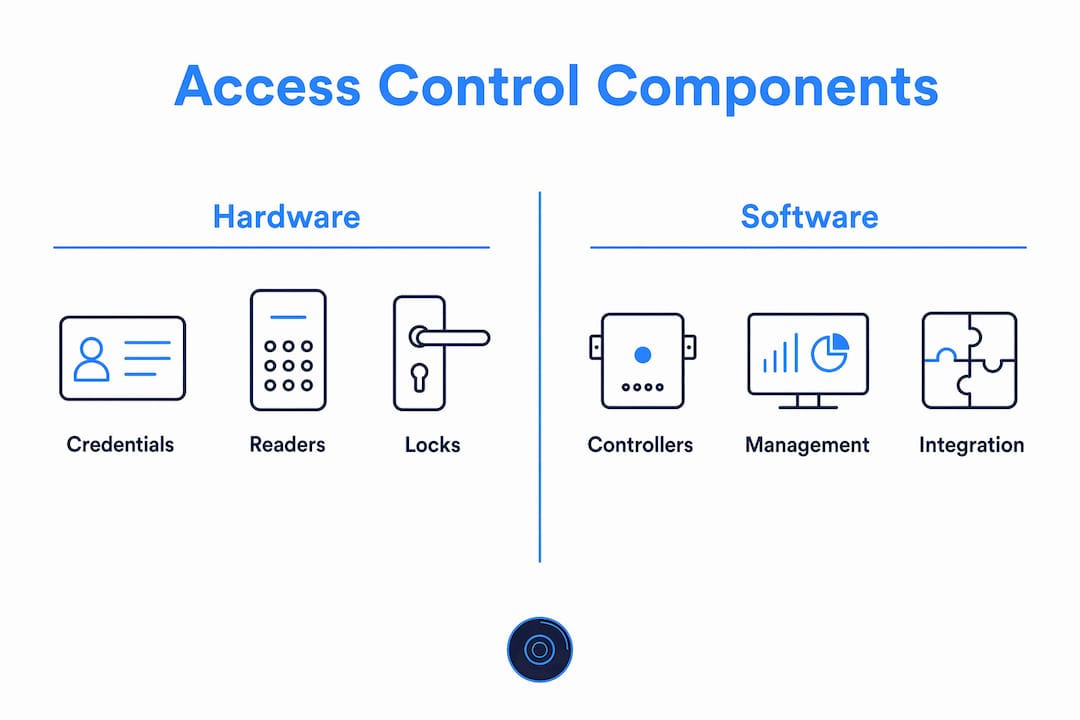
A functional integrated system requires four foundational elements: the credential, the reader, the decision-making controller, and the physical lock release or exit hardware. Each element must communicate reliably with the others for the system to enforce access policies consistently. Common credentials include RFID cards, mobile device identifiers, and biometric data such as fingerprints or facial recognition.
The centralized software layer is what separates true integration from simple hardware installation. It handles user management, event logging, policy enforcement, and remote configuration across all connected devices. Cloud-based platforms have simplified this management layer considerably, enabling real-time monitoring and integration with enterprise systems such as HR databases and building automation controls.
Siloed systems are operational liabilities in complex commercial environments. Integration eliminates those silos by creating a single source of truth for access events, user credentials, and security alerts. The convergence of physical and IT security is accelerating this demand, particularly as hybrid work models require remote access management and flexible credential provisioning.
What are the core components of an integrated access control system?
The hardware layer of an integrated system includes several distinct categories, each serving a specific function within the overall architecture.
Credential technologies define how users prove their identity. Options range from proximity RFID cards and PIN codes to mobile credentials delivered via Bluetooth or NFC, and biometric readers that verify fingerprints, iris patterns, or facial geometry. Each technology carries different security levels and user experience tradeoffs.
Controllers and readers form the decision layer. The reader captures credential data and passes it to the controller, which cross-references an access database and sends an unlock signal if the credential is authorized. Controllers can be panel-based, managing multiple doors from a central unit, or distributed, with intelligence embedded at each door.

Lock hardware and exit devices complete the physical layer. Electromagnetic locks, electric strikes, and electrified mortise locks each behave differently during power failure, which makes fail-safe versus fail-secure design a critical planning consideration. Emergency exits and power-loss scenarios must comply with life safety codes, and neglecting these physical realities is a common design mistake.
Pro Tip: Prioritize systems built on open APIs and published industry standards such as OSDP (Open Supervised Device Protocol) or ONVIF. Proprietary platforms are easier to install initially but create long-term vendor lock-in and higher replacement costs.
Open platforms that support industry standards enable interoperability with intelligent sensors, AI analytics, and building automation systems, protecting your technology investment as requirements evolve. Choosing open architecture from the start is the single most consequential decision in any integration project.
How does integration enhance security and operational efficiency?
Integrated access control delivers measurable improvements across both security posture and day-to-day operations. The gains come from combining systems that previously operated independently.
Integrating CCTV, alarms, visitor management, and building management into a unified platform gives security teams a single interface for monitoring and incident response. When an access event triggers an alarm, the integrated system automatically pulls the corresponding camera feed, reducing the time from alert to response. That speed is operationally significant in high-traffic commercial facilities.
The table below summarizes the primary operational benefits of integration compared to stand-alone systems.
| Benefit area | Stand-alone systems | Integrated systems |
|---|---|---|
| Incident response | Manual correlation across separate interfaces | Automated event linking with camera and alarm data |
| Credential management | Separate databases per system | Single unified user directory |
| Audit and compliance | Fragmented logs requiring manual compilation | Comprehensive, time-stamped audit trail |
| Maintenance overhead | Multiple vendor contracts and update cycles | Centralized management with consolidated support |
| Scalability | Hardware additions require separate configuration | New devices onboard through a single platform |
A comprehensive audit trail is one of the most cited benefits of unified systems, and it is directly relevant to regulatory compliance. Industries subject to HIPAA, SOC 2, or ISO 27001 requirements rely on detailed access logs to demonstrate control effectiveness during audits and incident investigations. Integration makes that log data accurate, complete, and retrievable.
Cost efficiency is a secondary but real benefit. Eliminating duplicative maintenance contracts, reducing manual administrative tasks, and avoiding the need to manage separate vendor relationships all reduce total cost of ownership over the system lifecycle. For facilities with multiple buildings or access points, the savings compound significantly.
What are common challenges in implementing access control integration?
Integration projects fail most often for predictable reasons, and understanding those failure points before planning begins is the most effective form of risk management.
Proprietary system lock-in is the most persistent structural risk. Vendors that sell closed, proprietary platforms create dependency that limits future flexibility and drives up replacement costs. The solution is to require open protocol support, published APIs, and documented interoperability standards before signing any procurement contract.
Physical exit path complexity catches many projects off guard. Every integrated door must account for emergency egress, fire alarm override, and power failure behavior. Experienced integrators plan for these edge cases explicitly, mapping fail-safe and fail-secure requirements to each door type before hardware selection begins.
Human factors remain a persistent vulnerability. Tailgating is the practice of an unauthorized person following an authorized user through a controlled door, and it represents a primary physical security gap that technology integration alone cannot close. Anti-tailgating hardware such as security vestibules, turnstiles, and optical barriers, combined with user education and clear access policies, are necessary complements to any integrated system.
Pro Tip: Involve cross-functional teams, including security, IT, facilities, HR, and legal, in the planning phase before any technology is selected. Misaligned requirements discovered after deployment are expensive to correct and often require partial system replacement.
User education and policy remain vital complements to technology in achieving strong physical security. The most technically advanced integrated system still depends on people following correct procedures at controlled entry points. Training is not optional; it is part of the integration itself.
What steps should organizations follow to integrate access control systems?
A structured implementation process reduces risk and improves outcomes. The following sequence reflects best practice for organizations of any size.
-
Conduct a full security audit. Map all physical and logical access points before selecting any technology. Document door types, user groups, existing lock hardware, fire and safety code requirements, and current credential systems. This baseline determines the scope and complexity of the integration project.
-
Define access policies and user groups. Establish who needs access to what, under which conditions, and with what level of audit detail. Policy definition drives hardware selection and software configuration. Skipping this step leads to systems that are technically functional but operationally misaligned.
-
Evaluate vendors on open standards compliance. Require demonstrated support for OSDP, ONVIF, or REST APIs. Test interoperability with your existing infrastructure before committing to a platform. Proprietary systems that cannot connect to your HR or building management systems will create new silos rather than eliminating them.
-
Design the system architecture. Select centralized management software, plan controller placement, specify credential technologies for each zone, and document fail-safe requirements for every controlled door. Architecture design should precede hardware procurement, not follow it.
-
Deploy in phases and test rigorously. Commission one zone or building at a time. Test every access scenario, including power failure, fire alarm override, and credential revocation, before expanding to the next phase. Full-facility deployment without phased testing is the most common cause of post-installation failures.
-
Train administrators and users. System administrators need hands-on training in the management platform. End users need clear guidance on credential use, tailgating prevention, and incident reporting procedures.
-
Establish a maintenance and update schedule. Regular maintenance and software updates are not optional post-integration tasks. Neglecting them leads to security vulnerabilities and degraded system performance. Schedule quarterly reviews of access policies, firmware versions, and credential databases.
For organizations evaluating integrated security systems for facilities, the planning phase is where the most value is created or lost. Thorough preparation consistently produces better outcomes than accelerated deployment.
YDA Security Systems NYC: your access control integration partner
YDA Security Systems NYC brings direct expertise in designing and implementing open, scalable integrated security platforms for commercial and residential properties across New York City. With over 5,000 satisfied clients and a 1-year warranty on all installations, YDA delivers systems built for long-term reliability, not just initial setup.

YDA’s licensed and insured technicians handle the full project lifecycle, from initial consultation and security audit through hardware deployment, software configuration, and ongoing system management. Every installation is tailored to the specific access requirements, compliance obligations, and operational workflows of the property. For decision-makers evaluating access control solutions in NYC, YDA offers a direct assessment of your current security posture and a clear integration roadmap. Contact YDA Security Systems NYC to schedule a consultation and receive a system design aligned with your facility’s specific needs.
Key takeaways
Access control system integration delivers its strongest results when open standards, thorough planning, and complementary security policies are combined from the start.
| Point | Details |
|---|---|
| Integration requires four core elements | Credential, reader, controller, and lock hardware must all connect through centralized software. |
| Open standards prevent lock-in | Require OSDP or ONVIF support to maintain flexibility and avoid proprietary dependency. |
| Audit trails support compliance | Unified systems generate complete, time-stamped logs essential for HIPAA, SOC 2, and ISO 27001 audits. |
| Tailgating needs physical countermeasures | Anti-tailgating hardware and user training are necessary complements to any integrated system. |
| Phased deployment reduces risk | Testing each zone before full rollout prevents costly post-installation failures. |
FAQ
What is access control system integration?
Access control system integration is the process of connecting credential readers, controllers, locks, cameras, alarms, and management software into a single centralized platform. It replaces disconnected, siloed systems with unified monitoring, policy enforcement, and audit capabilities.
What are the main types of access control systems?
The main access control system types are discretionary access control (DAC), mandatory access control (MAC), and role-based access control (RBAC). RBAC is the most common model in commercial environments because it assigns permissions based on job function rather than individual user decisions.
How does access control work in an integrated system?
A credential, such as an RFID card or biometric scan, is presented to a reader, which sends the data to a controller. The controller checks the credential against an access database and signals the lock to release if access is authorized. Centralized software logs the event and enforces policies across all connected doors simultaneously.
What are the biggest risks in access control integration projects?
The two most significant risks are proprietary vendor lock-in and inadequate planning for emergency egress and power failure scenarios. Both are avoidable through open standards requirements and thorough architectural design before hardware procurement begins.
How do emerging security technology trends affect access control integration?
AI-based analytics, mobile credentials, and cloud-based management platforms are reshaping how integrated systems are designed and operated. Organizations that choose open architecture today are better positioned to adopt these capabilities without replacing their core infrastructure.